Finding Low Mileage Used Jeeps: Buyer’s Guide
Then I stumbled onto a 3-year-old Wrangler Sahara with under 18,000 miles—and that completely changed how I shop for used Jeeps.
This guide is basically everything I wish someone had told me before I spent way too many weekends crawling under frames in dealership lots.
Why Low Mileage on a Jeep Actually Matters (But Not How You Think)
When I first started hunting for used Jeeps, I assumed lower mileage automatically meant “better Jeep.” After driving and inspecting more than a dozen Wranglers, Cherokees, and Grand Cherokees, I’ve learned it’s more nuanced.
Mileage is a clue, not a verdict. A Wrangler with 35,000 miles that’s been off-roaded hard can be in worse shape than a 70,000‑mile Grand Cherokee that lived an easy highway life.That said, low mileage does affect a few big things:
- Resale value – Data from Kelley Blue Book and Carfax trends shows low mileage vehicles usually pull a price premium of 5–15% compared with similar-year higher-mileage models.
- Remaining life on major components – Transmissions, suspension bushings, ball joints, and differentials generally wear with miles, not just years.
- Warranty potential – Some late-model Jeeps with low miles are still under powertrain warranty (5 years / 60,000 miles for many recent Jeep models).
When I tested a 2019 Wrangler Sport with 14,000 miles, all the wear items—pedals, steering wheel, seat bolsters—matched the odometer. That’s one of the first things I check now: does the interior wear feel like the mileage, or is something off?
Which Jeep Models Are Best to Buy Used with Low Miles?
I’ve driven or evaluated most of the common used Jeep models people hunt for. Here’s how they stack up if you’re specifically chasing low mileage.
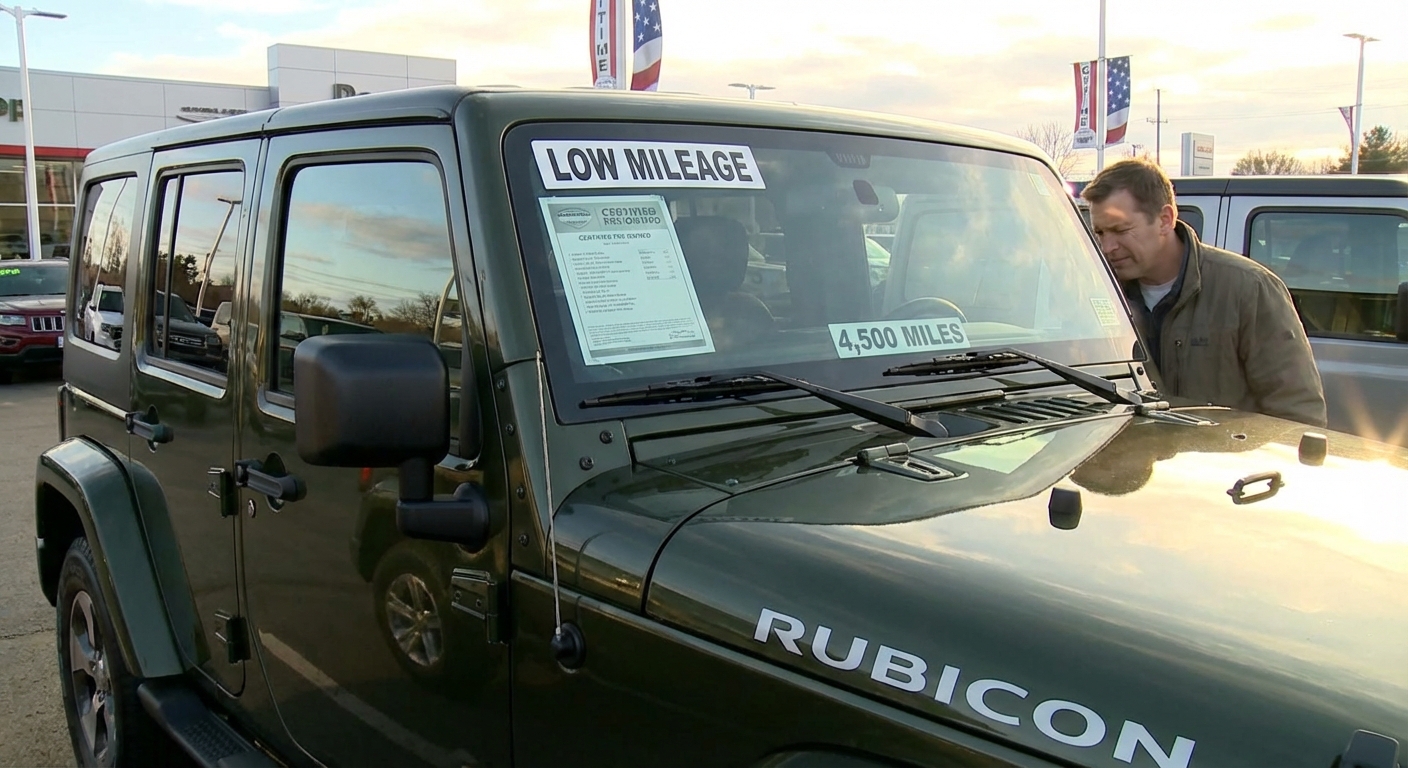
Jeep Wrangler (JK & JL)
Wranglers (two-door and four-door Unlimited) are the poster child for the Jeep life.
Why low mileage helps here:- These get used (and abused) off-road more than any other Jeep.
- Less miles usually means less trail damage, less frame rust from mud and water, and fewer DIY “mods” gone wrong.
In my experience, a low-mileage JL (2018+) is the sweet spot. The 3.6L Pentastar V6 is proven, and the newer 8-speed automatic is way better than the old 5-speed.
Jeep Grand Cherokee
If you care more about comfort and daily usability than rock-crawling, low-mileage Grand Cherokees are gold.
I drove a 2017 Grand Cherokee Limited with 40k miles and air suspension, and it felt almost new—quiet cabin, tight steering, no weird drivetrain noises.
What I like about low-mile Grand Cherokees:- Often owned by families or commuters, not off-road fans
- Better maintenance histories (oil changes, dealer service)
- Tons of safety and tech features that still feel current
Jeep Cherokee & Compass
These are the “sensible” Jeeps. Low-mile examples can be very good value, especially for people who want Jeep styling and light off-road capability without Wrangler gas mileage.
In my experience, low mileage matters more here for transmission health. Some earlier Cherokees had 9-speed automatic quirks. Fewer miles + documented software updates is what I look for.
What Counts as “Low Mileage” for a Used Jeep?
Industry average mileage in the U.S. hovers around 12,000–15,000 miles per year according to the U.S. Department of Transportation.
Rough rule of thumb I use when I’m scanning listings:
- Under 8,000 miles/year: Very low mileage
- 8,000–12,000 miles/year: Normal, healthy usage
- 12,000–18,000 miles/year: High, but not crazy
- Over 18,000 miles/year: Heavy-use vehicle
So, a 5-year-old Wrangler with 30,000 miles? That’s low mileage. A 3-year-old Grand Cherokee with 55,000 miles? That’s average to slightly high.
One time I checked out a 4-year-old Wrangler with just 9,000 miles. Sounds dreamy, right? After driving it, I realized it sat a lot—tires were dry-cracked, brakes were rusty, and some seals were starting to seep. Low miles, yes. Low useful wear, not so much.
Where I Actually Find Low Mileage Used Jeeps
I’ve had the best luck in three places:
1. Franchise Jeep Dealerships (Certified Pre-Owned)
Certified Pre-Owned (CPO) Jeeps usually have:
- Age and mileage caps (often under 5–6 years, 75k miles)
- Multi-point inspections
- Extended powertrain warranties
When I tested a CPO 2020 Wrangler at a Jeep dealer, I got the full service history printout, recall status, and the actual inspection sheet. Was it more expensive than a private sale? Yes. Was the transparency worth it for many buyers? Also yes.
2. Private Sellers in Suburbs (Not the Cool Mountain Town)
The lowest-mile Jeeps I’ve seen were owned by:
- Retirees
- Families who outgrew the Wrangler phase
- People who bought a Jeep as a second car “just for fun”
I once found a 2016 Wrangler Sahara with 22,000 miles in a quiet suburb, owned by a couple who only used it on weekends. The underside looked like it had never seen gravel, let alone rocks.
3. Nationwide Search Tools
Sites like Autotrader, Cars.com, and CarGurus let you filter by maximum mileage, model year, trim, and distance. I usually:
- Set max mileage (e.g., 40,000)
- Expand search radius to 250+ miles
- Sort by lowest mileage first, then price
It sounds tedious, but that’s how I spotted some insane deals—like a low-mile Grand Cherokee two states away that was still cheaper, even after a fly-and-drive.
How I Verify a Low-Mileage Jeep Isn’t a Time Bomb
Low miles don’t protect you from bad maintenance or flood damage. Here’s my real-world checklist.
1. Run a Vehicle History Report
I always pull a Carfax or AutoCheck report. I’m looking for:
- Title issues (salvage, flood, lemon buyback)
- Mileage jumps or rollbacks
- Regular service intervals (oil changes, inspections)
If the mileage jumps from 5,000 to 45,000 in a year, or there’s a big unexplained gap, I walk.
2. Read the Odometer Against the Wear
I literally touch things:
- Steering wheel: smooth and shiny = higher real mileage
- Pedals: rubber worn down or corners rounded
- Seat bolsters: crushed, cracked, or sagging
Once I sat in a “19,000-mile” Wrangler whose driver’s seat looked like it had 90k on it. I didn’t even bother with a test drive after that.
3. Inspect the Undercarriage
Wranglers especially tell their story from below.
I look for:
- Bent skid plates
- Heavily scraped differentials or control arms
- Rust on frame welds and body mounts
- Caked-on dried mud in hidden pockets (sign of heavy off-roading)
If the seller claims “never off-roaded” and I see rock rash on the transfer case skid, I assume they’re either forgetful or not honest. Either way, I move on.
4. Get a Pre-Purchase Inspection
The best $150–$250 you can spend.
I take the Jeep to an independent mechanic (ideally one who knows Jeeps). I ask them to check:
- Compression (if older, higher miles)
- Suspension play and bushing wear
- Leaks around the oil pan, rear main seal, transmission, and transfer case
- Steering components (Wranglers are notorious for loose steering when worn)
When I tested that low-mile Wrangler Sahara, my mechanic found a very minor rear main seal seep and slightly uneven tire wear. Not dealbreakers, but enough for me to negotiate the price down.
Pros and Cons of Going Low Mileage on a Used Jeep
After chasing low-mile Jeeps for a few years, here’s how it shakes out.
Pros
- Higher resale value – Easier to sell later without scaring buyers with big odometer numbers.
- Less wear on big-ticket items – Engine, transmission, differentials, and suspension typically have more life left.
- Better chance of clean history – Fewer owners, more consistent maintenance.
Cons
- Price premium – You’re often paying thousands more for fewer miles.
- “Garage queen” problems – Sitting too much causes dry seals, battery issues, and surface rust on brakes.
- False sense of security – Low miles can trick you into skipping a proper inspection.
I’ve honestly seen some 80,000‑mile Jeeps that I’d buy over a “too perfect” 20,000‑mile one, just because the higher-mile one had impeccable service records and felt mechanically tight.
Negotiating a Low Mileage Jeep Without Getting Steamrolled
When I tested a 2018 Wrangler Sahara with 26,000 miles at a dealer, they proudly showed me the Carfax and then quoted a price that made me choke on my coffee.
Here’s what helped me negotiate sanely:
- Research comparable listings – I pulled 4–5 similar Jeeps (same year, trim, close mileage) on Autotrader and used that as my reality check.
- Separate emotion from value – Yes, that lifted Rubicon looks awesome. No, you don’t have to pay an extra $4k because you’re in love with the color.
- Use inspection findings as leverage – Any seep, tire wear, or maintenance due (brakes, tires, fluids) is a line item you can turn into a discount.
- Be willing to walk – The more I was okay with leaving, the better the deals got. Simple, but it works.
When a Higher Mileage Jeep Might Be the Better Buy
This sounds like heresy in a low-mile guide, but I’ve passed on some low-mile Jeeps in favor of slightly higher mileage ones.
I’d personally pick:
- A 2018 Wrangler with 55,000 miles, one-owner, full dealer service history, no accidents
- Over a 2018 Wrangler with 18,000 miles, sketchy history, questionable mods, and a seller who “can’t find the maintenance receipts”
Mileage is a powerful data point, but condition, history, and how the Jeep actually drives should be the final deciders.
When I tested that high-mileage-but-loved Wrangler, the steering was tight, the transmission shifted cleanly, and there were zero weird noises at highway speed. That drove my decision way more than the odometer alone.
Final Thoughts from the Driver’s Seat
If you’re hunting for low mileage used Jeeps, think of the process as detective work, not a simple numbers game.
In my experience, the best low-mile Jeeps share three things:
- The mileage matches the story the seller tells
- The wear you can see matches the mileage on the dash
- A mechanic you trust signs off after a deep inspection
Get those three right, and you’re not just buying a used Jeep—you’re buying years of road trips, dirt roads, questionable shortcuts, and probably at least one camping story where you say, “I’m really glad I bought this one.”
Sources
- U.S. Department of Transportation – Average Annual Miles per Driver - Federal data on how many miles Americans typically drive per year
- Kelley Blue Book – Used Car Values and Mileage Impact - Explains how mileage affects vehicle value and pricing
- Jeep Official Warranty Information - Details on factory and powertrain warranties for Jeep models
- Carfax – Vehicle History Reports Guide - Overview of what’s included in vehicle history reports
- Consumer Reports – Guide to Buying a Used Car - Independent advice on inspecting and evaluating used vehicles