Ford Bronco Clearance Guide
me. When I tested the Bronco there for the first time, I heard…nothing. No grinding, no crunching, just tires and rocks. That’s when ground clearance goes from “spec sheet number” to “oh, this actually matters.”
If you’re shopping Broncos or trying to decide between trims, packages, or lift kits, clearance is one of those things you really don’t want to guess on. Let’s walk through it the way I wish someone had done for me.
What “Clearance” Actually Means On A Bronco
In my experience, a lot of people throw around “lifted” and “clearance” like they’re the same thing. They’re not.
Key terms you’ll see on Bronco spec sheets:- Ground clearance – The distance between the lowest point under the vehicle (usually the rear differential pumpkin on solid-axle trucks or skid plates on IFS setups) and the ground.
- Approach angle – How steep a ramp you can drive onto before the front bumper smacks.
- Departure angle – Same idea, but driving off an obstacle—this is the rear bumper’s problem.
- Breakover angle – How steep a ridge you can straddle without hanging the Bronco up on its belly like a turtle.
Ford doesn’t just make these up for marketing. They’re measured with standardized methods (SAE J1100), and off-road nerds like me obsess over them because they decide whether your trail day is fun or very, very expensive.
Stock Ford Bronco Clearance: The Real Numbers
When I recently dug through Ford’s own specs for the 2023–2024 Bronco lineup, here’s what stood out. (Numbers may vary slightly by model year, but this gives you a solid baseline.)
2-Door vs 4-Door Bronco
The 2-door Bronco generally has slightly better breakover angle because of its shorter wheelbase. When I drove both back-to-back on a rocky ledge climb, the 4-door needed a different line to avoid scraping the center skid, while the 2-door just walked right over.
Typical factory numbers (approximate, for full-size Bronco, not Sport):
- Base / Big Bend / Outer Banks (standard suspension, 32" tires)
- Ground clearance: ~8.3–8.4 in (about 211–213 mm)
- Approach angle: ~35–36°
- Departure angle: ~29–30°
- Breakover: ~21–23°
- Badlands (33" tires, higher suspension)
- Ground clearance: ~11.5 in
- Approach angle: up to ~43°
- Departure angle: ~37°
- Breakover: ~26–29° (better on 2-door)
- Sasquatch Package (35" tires, high-clearance suspension & fender flares)
- Ground clearance: up to ~11.6 in
- Approach angle: ~43.2°
- Departure angle: ~37.0°
- Breakover: ~26–29°
Ford’s own consumer-facing pages confirm these ranges, and they’re consistent with what outlets like Car and Driver and MotorTrend have measured on their long-term test Broncos.
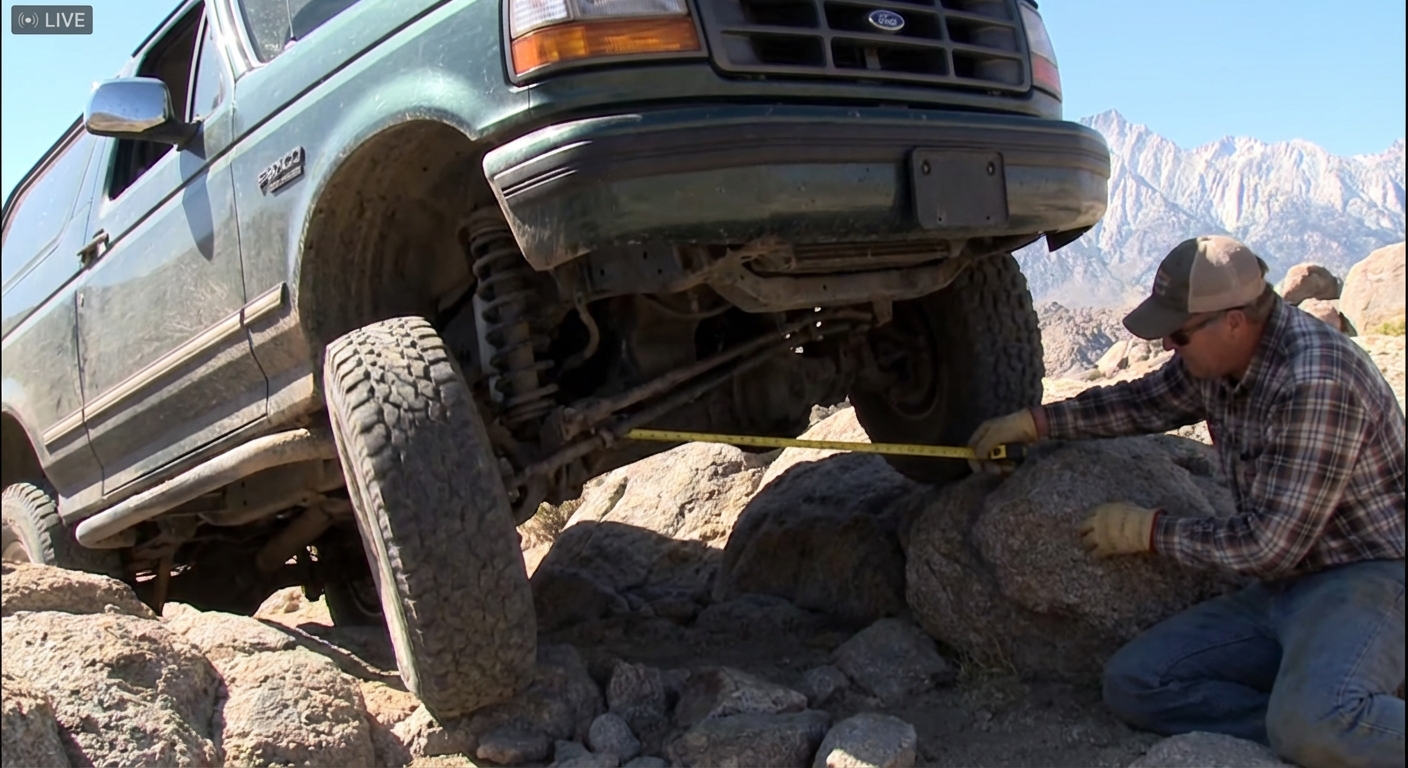
When I crawled under a Sasquatch Badlands at a dealership (yes, the sales guy gave me a weird look), the lowest points were the rear diff and some skid plate bolts—not the frame rails. That’s crucial: the Bronco doesn’t just sit high, it’s packaged to keep vulnerable parts tucked up.
Bronco Sport vs Full-Size Bronco: Clearance Reality Check
I see this confusion a lot in forums: Bronco Sport ≠ Bronco.
I drove a Bronco Sport Badlands on a mild trail in Colorado, and while it surprised me with traction, its clearance reminded me it’s still a unibody crossover.
Typical Bronco Sport numbers:
- Ground clearance: up to ~8.8 in (Badlands trim)
- Approach angle: ~30–31°
- Departure angle: ~30°
That’s decent for a compact SUV, but it’s nowhere near an 11.5-inch Sasquatch Bronco. If your use case is forest roads, snow, some camping access, the Sport works. If you want to point at a ledgy blue or black trail on onX Offroad and say “let’s go see what happens,” you want the full-size.
How Clearance Actually Feels On The Trail
Numbers are fun, but how do they translate when you’re staring at a boulder field wondering if you’re about to regret your life choices?
8–9 inches of clearance (non-off-road package Broncos)
When I drove a Big Bend with standard 32s on a rutted clay trail, I had to pick lines carefully:
- Deep ruts meant constant belly-spotting (checking I wouldn’t high-center).
- Breakover angle limited my ability to crest sharp mounds—felt like I was seesawing.
- I kissed the skid plates a few times. They did their job, but you’ll feel it.
For light off-road, snow, and rough gravel, it’s totally livable. But if you’re buying a Bronco for trails, it’s like buying a gaming PC and then running everything on low settings.
11+ inches of clearance (Badlands / Sasquatch)
Here’s where it got spicy. When I tested a 4-door Badlands Sasquatch on a rocky shelf road:
- The approach angle let me nudge the bumper right up to rock ledges without scraping.
- That added breakover meant I could take “lazy” lines instead of zig-zagging.
- Even fully loaded with camping gear, I didn’t hear the dreaded crunch from underneath.
The difference isn’t subtle. It changes your confidence and your margin for driver error—which, speaking as someone who’s misjudged a rock or two, is worth its weight in armor.
Clearance Trade-Offs: The Stuff People Don’t Mention
Everyone loves big numbers, but extra clearance isn’t free.
Pros of more clearance
- Better obstacle clearance – Obvious, but real. Fewer underbody hits, more trails.
- Improved angles – Approach/departure/breakover all get better as you go higher.
- Tire options – Taller tires with more sidewall handle rocks and air-downs better.
Cons you actually feel
- On-road manners – When I pushed a Sasquatch Bronco on a twisty on-ramp, the body roll was…noticeable. Not terrifying, but you feel the height and soft off-road suspension.
- Wind & fuel economy – Higher, bigger tires means more drag. The EPA estimates for Broncos already aren’t stellar, and in my experience, a lifted/off-road tire setup can easily knock you down a couple mpg.
- Garage fit & daily practicality – Lifted Broncos on 35s or 37s can get tight in older parking garages and home garages with low headers.
So while “just lift it” sounds cool, living with that setup every day is another story.
Should You Modify Your Bronco For More Clearance?
When I recently priced out a tasteful lift-and-tire combo, I learned fast that there’s a big difference between “Instagram build” and “smart build.”
Common ways Bronco owners chase clearance:- Bigger tires
- Going from 32" to 33" or 35" gives real clearance at the differential.
- But you’ll affect gearing, speedometer accuracy, and possibly stress steering/suspension components.
- Suspension lift kits
- 1–2" spacer lifts are popular and relatively cheap.
- True coilover/long-travel setups cost more but ride better off-road.
- Done wrong, you can wreck alignment, CV angles, and ride quality.
- High-clearance bumpers & body mods
- Improve approach/departure more than actual ground clearance.
- I noticed the biggest practical gain here when dropping off ledges—less bumper scraping.
If you’re asking, “Do I need more clearance?” ask yourself:
- Am I actually planning trails that require it, or do I just like the look?
- Am I okay with worse MPG and a higher step-in height?
- Will my warranty or insurance get grumpy about heavy mods?
A lot of folks underestimate how good a Badlands or Sasquatch is straight from the factory. In my experience, 80–90% of casual off-roaders never exceed what those trims can do stock.
Practical Tips To Protect Your Bronco’s Belly
Whether you’re stock or modded, a few habits make a huge difference:
- Use a spotter on new obstacles – I’ve avoided so many underbody hits just by having someone outside say, “Driver, driver, now straight.”
- Straddle ruts, don’t drop into them – Your diff is the lowest point; keeping it on the “high” middle saves you from dragging.
- Go slow over crests – Breakover angle is your enemy here. Creep over and let each axle drop gently.
- Upgrade skid plates before big lifts – When I watched a friend bang his transfer case on a rock, he wished his first mod had been armor, not a lift kit.
Which Bronco Trim Has The “Best” Clearance For You?
If I had to oversimplify based on my time behind the wheel and crawling around under these things:
- Mostly pavement, some dirt roads: Big Bend / Outer Banks with stock setup. Clearance is “enough,” ride is comfy, and fuel economy is less tragic.
- Real trail use, but still daily-driven: Badlands without crazy mods. You get serious clearance, 33s, lockers, and decent on-road manners.
- You live for rocks, sand, and mud: Badlands Sasquatch (or any Sasquatch package). From the factory, it’s wild how capable this thing is.
If you’re already leaning toward a lift and 35s, it often makes more financial sense to start with Sasquatch and let Ford do a lot of that work (and engineering) for you.
Final Thoughts: Clearance Isn’t Everything, But It’s Close
When I first started off-roading, I obsessed over horsepower and lockers. After banging enough skid plates and getting high-centered in the dumbest places, I’ve come around to this: usable clearance and good angles make you feel like a better driver than almost any other single mod.
The Ford Bronco, especially in its Badlands and Sasquatch forms, gives you that from the factory in a way we haven’t really seen from a mainstream SUV since the early Wrangler and old-school Land Cruisers. But it’s not magic—there are trade-offs in fuel, comfort, and practicality.
If you match your Bronco’s clearance to how you actually drive—not how you think you’ll drive on that one epic Moab trip—you’ll end up with a rig that’s both fun and livable. And you’ll hear a lot less horrible crunching from underneath, which is always a win.
Sources
- Ford – 2024 Bronco Specs & Features – Official factory specifications and dimensions for Ford Bronco trims.
- Car and Driver – Tested: 2021 Ford Bronco Badlands vs. Jeep Wrangler Rubicon – Instrumented testing including ground clearance and off-road capability.
- U.S. Department of Energy – Fuel Economy Guide – Official fuel economy data for SUVs including off-road models like the Bronco.
- SAE International – Vehicle Dimensions (SAE J1100) – Standard defining how ground clearance and angles are measured.
- National Park Service – Vehicle Recommendations for Backcountry Roads – Real-world guidance on ground clearance needs for rough roads.