Guide to Car Carpet Replacement and Interior Floor Mat Options
zard under there. Rust starting at the seat mounts, spilled coffee fossilized into the padding, and a smell that Febreze physically ran away from.
That was the day I fell down the rabbit hole of car carpet replacement and interior floor protection. Since then, I’ve done full carpet swaps on three personal cars and helped friends upgrade from flimsy dealer mats to serious, weather-ready setups.
This guide is exactly what I wish I had when I started.
Why Your Car’s Carpet Matters More Than You Think
When I ripped out that first carpet, I realized it isn’t just “decoration.” It does a lot of quiet heavy lifting:
- Sound insulation – The carpet plus its jute or foam underlay deadens road noise and drivetrain vibration. When I tested driving my sedan with the carpet removed, the cabin sounded like a tin can at highway speeds.
- Thermal insulation – Especially above the transmission tunnel and near the firewall. I once drove a project car with no carpet in summer; the floor was almost too hot in flip-flops.
- Resale value and first impression – Buyers absolutely judge a car by the interior. A clean, fresh carpet made a bigger difference to one buyer than the new tires I’d put on.
- Corrosion control – Wet carpet that stays damp can quietly rot your floor pan from the inside out.
So if your carpet smells, is permanently stained, or is crumbling, replacing it isn’t just cosmetic—it’s preventative maintenance.
Should You Replace the Carpet or Just Upgrade Floor Mats?
Before you grab tools and start yanking seats out, it’s worth deciding how deep you need to go.
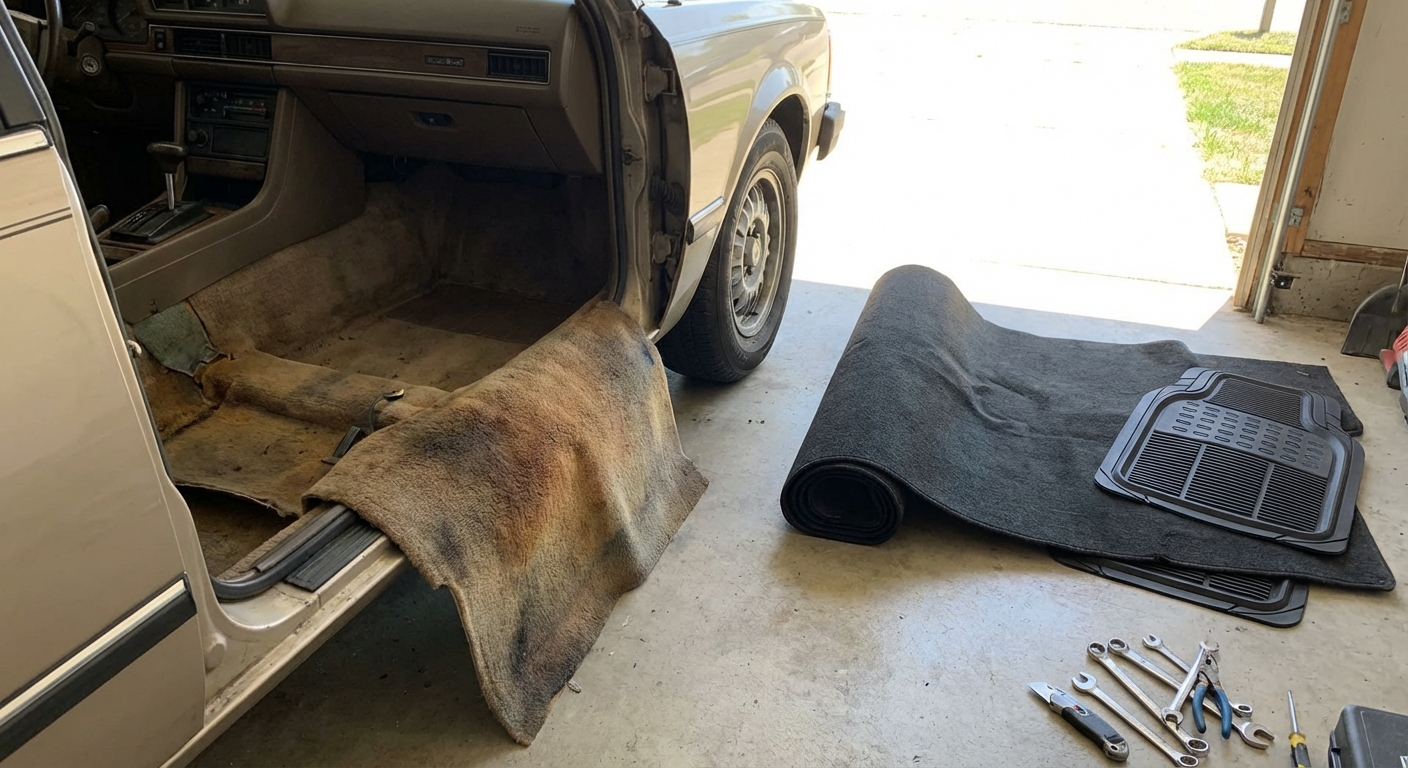
When floor mats alone are enough
In my experience, you can usually stop at mats if:
- The carpet is structurally fine (no holes, no mold, no crumbling backing)
- Odors go away with a proper extraction cleaning
- You’re mostly dealing with future protection, not damage that’s already done
A good set of high-wall rubber or TPE (thermoplastic elastomer) mats can dramatically upgrade protection without surgery-level interior work.
When you should consider full carpet replacement
I pull the trigger on replacement when:
- There’s a persistent musty or sour smell even after deep cleaning
- The carpet backing is dry-rotted or turning to dust
- There are burn marks, bleach spots, or large torn sections
- I find surface rust or damp padding when I lift a corner
- I’m doing a full interior refresh on an older build and don’t want to put clean parts over nasty flooring
If you’re seeing rust, especially near seat mounts or the firewall, ignoring it is gambling with safety and long-term repair costs.
Types of Replacement Car Carpet: What Actually Works
When I started, I assumed all replacement carpets were the same. They are absolutely not. Here’s what I’ve learned (sometimes the hard way).
1. Molded vs. cut-and-sewn carpet
- Molded carpet: Pre-formed to your specific vehicle’s floor pan with contours for the transmission tunnel and footwells.
- Pros: Cleaner OEM-style fit, less trimming, looks factory when done right.
- Cons: More expensive, can be a pain if quality control is bad or if it ships folded and creased.
- Cut-and-sewn carpet: Flat sections that you cut and shape yourself.
- Pros: Cheaper, more flexible for custom interiors or older vehicles.
- Cons: Takes more patience, more room for error, and can look “aftermarket” if you rush it.
Whenever there’s an option, I go molded for daily drivers. It’s closer to OEM and saves hours.
2. Material: Loop, cut pile, and others
Most aftermarket carpets fall into two big buckets:
- Loop pile (think classic VW or older American cars)
- Durable, hides dirt well, retro look
- Feels slightly rougher underfoot
- Cut pile (what most modern cars use)
- Softer, plusher feel
- Shows debris more but vacuums up easier in my experience
Higher-end options sometimes add mass-backed carpet, which has a dense rubber backing. When I tested this in a noisy compact, cabin noise dropped a noticeable amount at highway speeds—especially tire roar.
DIY Carpet Replacement: What It’s Really Like
I’ve done this job on my garage floor, on a gravel driveway, and in a cramped carport. It’s absolutely DIY-able, but you want realistic expectations.
Basic process (from my last install)
Here’s the rough flow I follow:
- Disconnect the battery – Modern cars have seat airbags and wiring everywhere. I learned this the nervous way when an airbag light came on after unplugging a seat without killing power.
- Remove seats and center console – Front seats, sometimes the rear bench, plus trim along the rocker panels.
- Pull old carpet and padding – Cut it if needed; you’re not saving it.
- Inspect and treat the floor – This is where I’ve found coins, old French fries, and once a house key from a previous owner.
- Wire-brush any surface rust
- Use rust converter or primer where needed
- Test-fit the new carpet – Lay it in the sun first if you can; heat helps it relax and mold.
- Trim carefully around seat bolts and shifters – I always sneak up on cuts gradually. You can’t un-cut.
- Reinstall trim and seats – Torque the seat bolts properly; they’re part of the crash safety system.
For a first-timer, budget a weekend, not an afternoon. The last one I did on a midsize sedan took me around 7–8 hours of honest work, including cleaning and rust treatment.
DIY vs. pro install
- DIY pros: Save $300–$800 in labor, total control over cleaning and rust prevention, satisfying to see the transformation.
- DIY cons: Time-consuming, physically awkward, easy to scratch interior trim if you rush.
- Pro install pros: Faster, usually cleaner fit, no crawling around on the floor wondering where that one clip goes.
- Pro cons: Labor can easily match or exceed the carpet’s cost, and not all upholstery shops are equally detail-oriented.
If your car has lots of electronics and you’re not comfortable around wiring and airbag connectors, paying a reputable shop once might be cheaper than chasing electrical gremlins later.
Interior Floor Mat Options: From Cheap to “Never Worry Again”
Even with brand-new carpet, you’re only halfway there. Mats are the front line of defense.
Over the years I’ve rotated through pretty much every style:
1. Universal rubber mats
These are the cut-to-fit sets at big box stores.
What I’ve found:- Cheap and easy to replace
- Usually don’t cover the dead pedal or the sides of the footwell
- They slide around if the retention clips don’t line up (and a sliding mat under the pedals is no joke)
Good as a short-term or beater-car solution, but not my pick for a nice interior.
2. Carpeted mats (OEM-style)
Most cars come with these from the factory.
Pros:- Look upscale and match the interior
- More comfortable if you drive barefoot or in thin shoes
- Soak up water and salt in winter
- Stain easily with coffee, mud, and greasy work boots
When I tested these in a salty, slushy winter climate, they were overwhelmed in about three weeks.
3. Custom-fit all-weather liners
Think WeatherTech, Husky Liners, OEM “all-weather” mats, etc.
These changed the game for me.
- Laser-measured to hug your exact floor shape
- High side walls to trap snow, salt, sand, and spills
- Materials like TPE are flexible in the cold and don’t crack like old-school hard plastic
In my daily driver, I once dumped half a large iced coffee onto the passenger mat. It pooled inside the liner, I pulled it out, dumped it, hosed it off, and the carpet underneath was bone dry. That alone converted me forever.
Trade-offs:- Can look a bit utilitarian or “trucky” in a luxury interior
- Some cheaper sets have a plasticky feel or odor for the first week
4. Hybrid and premium options
There’s a newer crop of mats that blend style and practicality—multi-layer designs, removable carpet inserts over a waterproof base, and even 3D molded mats with a softer surface.
I tried a set with a removable cloth topper over a rubber tray. Surprisingly good: daily dirt stuck to the cloth, I’d pull, vacuum, reattach, and the tray below stayed pristine.
Matching Mats and Carpet to Your Life (Not Just Your Car)
Here’s how I usually help friends choose:
- Wet, snowy, or muddy climate:
- Full replacement carpet if the existing one is damaged or moldy
- Custom-fit all-weather liners year-round
- Dry, mostly urban driving:
- Keep good OEM carpet, deep clean it
- Go with quality carpeted mats or hybrid mats
- Kids, pets, or messy hobbies:
- Darker carpet color (hides stains and scuffs)
- High-side all-weather mats at least in the second row and cargo area
Also: don’t underestimate color. I once swapped a beige carpet to black in a small hatchback. The interior instantly looked newer, and it was way less stressful tracking in a little dirt.
Common Mistakes I See (And Have Made)
- Skipping rust treatment: If you see even light surface rust under the carpet and just cover it back up, you’re basically slow-cooking a future hole.
- Cutting too aggressively: I ruined one molded carpet by cutting the shifter opening too big. Now I always outline with chalk first and cut small.
- Ignoring mat retention systems: Those little clips and hooks aren’t optional. A mat jammed under the accelerator pedal is a safety issue, not an aesthetic one.
- Cheap, smelly mats: Low-grade rubber and PVC can off-gas for months. I’ve had one set that never stopped smelling like a tire shop; it went straight to the trash.
Final Thoughts: What’s Actually Worth Your Money
If you forced me to prioritize based on my experience:
- If your carpet is bad:
- Invest in a quality molded, mass-backed replacement
- Take the chance to clean and rust-proof the floor properly
- For everyday protection:
- Go for custom-fit all-weather liners that match your vehicle specifically
- Keep a cheap portable vacuum in the trunk; prevention beats scrubbing
- If you’re on a tight budget:
- Rent or borrow a carpet extractor and deep-clean your existing carpet
- Upgrade to the best-fitting mats you can afford, even if they’re not a big brand
The combo of fresh, properly installed carpet and well-designed mats genuinely changes how a car feels—from “old and tired” to “I kind of love driving this again.” Every time I step into one of the cars I’ve redone, it feels like a different vehicle.
Sources
- National Highway Traffic Safety Administration – Floor Mat Safety Advisory - Guidance on floor mat use and pedal interference risks
- WeatherTech – DigitalFit FloorLiner Product Info - Example of custom-fit all-weather liner design and materials
- U.S. Environmental Protection Agency – Vehicle Interior Air Quality - Discussion of interior contaminants and off-gassing
- 3M – Automotive Soundproofing and Insulation Overview - Technical background on noise and thermal insulation in vehicle cabins
- University of California, Berkeley – Rust and Corrosion Basics - Fundamentals of corrosion processes relevant to floor pan rust