Guide to Comparing Compact 4x4 Vehicle Capabilities
sover in wet sand on a beach access trail and had to get dragged out by a slightly rusty, very smug Suzuki Jimny.
That day flipped a switch for me.
Since then, I’ve driven and tested everything from Subaru’s symmetrical AWD systems to ladder-frame mini 4x4s like the Jimny and hardcore trims like the Jeep Wrangler Rubicon and Ford Bronco Badlands. When you start comparing compact 4x4 vehicle capabilities properly, you realize the badge on the tailgate tells you almost nothing.
This guide is the framework I wish I’d had before I started test-driving.
4x4 vs AWD: The First Big Filter
When I tested a Subaru Forester Wilderness back-to-back with a Suzuki Jimny, I finally understood the AWD vs 4x4 difference in the real world.
- The Forester’s AWD system was brilliant on gravel, wet mountain roads, and light trails. It felt planted and safe.
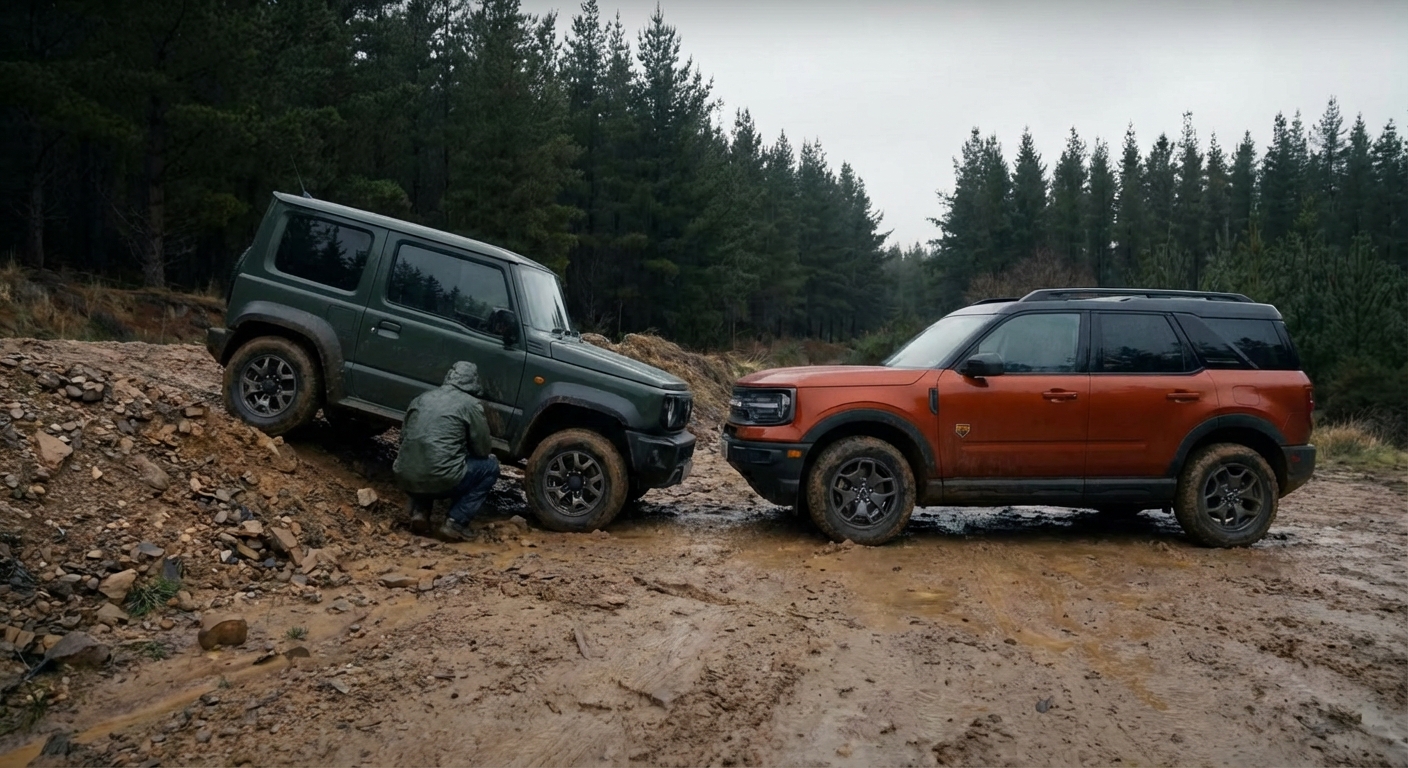
- The Jimny, with its proper part-time 4x4 and low range, felt clumsy on pavement… but once I dropped into 4L on a rocky climb, it walked up like a tiny mountain goat.
Here’s how I separate systems when comparing compact 4x4s:
Usually full-time, computer-controlled. Great for:
- Snowy roads
- Rain, mud, gravel
- Light off-pavement adventures
Selectable 2H/4H/4L via lever or dial. Better when you:
- Need torque at very low speeds (rock crawling, steep climbs)
- Spend serious time off-road
In my experience, if your driving is 90% city and highway with occasional dirt tracks, a good AWD system (like Subaru’s, or Toyota’s Dynamic Torque Control AWD) is more comfortable and more fuel-efficient.
If you’re regularly tackling ruts, steep fire roads, or towing on uneven surfaces, you’ll want a proper transfer case with low range.
The Four Capability Pillars I Always Compare
When I’m seriously evaluating compact 4x4s, I break capability down into four pillars:
- Traction & Drivetrain
- Ground Clearance & Angles
- Chassis & Suspension
- Real-World Usability
I’ll walk through each, with the stuff that actually matters when you’re standing in a dealership lot or scrolling listings.
1. Traction & Drivetrain: The Stuff You Can’t See But Will Feel
The marketing terms get ridiculous here, so I focus on a few hardcore details.
Locking Differentials (The Secret Sauce)
When I tested a Jeep Wrangler Rubicon on a deeply rutted trail, I deliberately eased it into a cross-axle situation: front left and rear right wheels in the air.
- With lockers off, it scrabbled and spun.
- Flip the front and rear lockers on, and it crawled out like nothing happened.
In compact 4x4s, check for:
- Center diff lock or equivalent (often a mode in AWD systems)
- Rear locking differential (rare but gold – e.g., some Bronco Sport trims, some Jimny specs)
If a vehicle has:
- No lockers, no low range, and mainly “modes”: it’s usually a soft-roader.
- Low range + at least a rear locker or strong traction control: now we’re in serious capability territory.
Traction Control & Drive Modes
Modern compact 4x4s rely heavily on brake-based traction control and terrain modes:
- Sand, Mud, Snow, Rock modes adjust throttle, gear shifts, and traction logic.
When I drove the Ford Bronco Sport on a sandy trail, the GOAT modes (Goes Over Any Terrain) genuinely made a difference. In Sand mode, the throttle stayed more responsive and the wheels spun just enough to stay on top of the soft surface.
The catch: these systems can fade when overheated if you’re really hammering them, and no software can fully replace a proper mechanical locker.
2. Ground Clearance & Angles: Where Metal Meets Dirt
I’ve high-centered more vehicles than I’d like to admit. The pattern is always the same: great power, decent traction… and then the underbody kisses a rock and you’re stuck.
Three specs I always look at:
- Ground Clearance (measure under the lowest point, usually the diff or crossmember)
- Around 7–8 inches (180–200 mm): light-duty trails only
- 8–9.5 inches (200–240 mm): respectable for compact 4x4s
- 9.5+ inches (240+ mm): very capable out of the box
- Approach Angle: how steep a ledge you can drive up without hitting the front bumper.
- Departure Angle: same idea, but for the rear.
- Breakover Angle: how sharply you can crest a hill without scraping the middle.
When I compared a Subaru Crosstrek Wilderness to a Jimny on a steep dirt mound:
- The Crosstrek’s better breakover surprisingly kept it from getting beached.
- The Jimny’s short overhangs and ladder frame made it feel almost invincible on steep approach and departure angles.
If a compact 4x4 looks low and has long front/rear overhangs, it’ll struggle off-road no matter how fancy the traction modes are.
3. Chassis, Suspension & Tires: The Underestimated Trio
Unibody vs Ladder Frame
Most compact SUVs are unibody, like a car. They’re lighter, safer on-road, and more comfortable.
True mini 4x4s like the Suzuki Jimny or Jeep Wrangler use a ladder frame:
- Better for twisting, flexing, and taking hits off-road
- Heavier, less efficient, more truck-like handling
In my experience, if you’re commuting daily and only wheeling on weekends, a good unibody with well-tuned suspension is actually the sweet spot.
Suspension Setup
I look for:
- Wheel articulation: how well the suspension keeps tires on the ground
- Independent front suspension is almost universal in compacts now; solid rear axles still show up on more hardcore models
- Skid plates and underbody protection: absolutely mandatory if you’re serious about trails
On a rocky trail test day, a stock crossover with no skid plates left me wincing every time I heard a “clunk” from underneath. A lightly armored compact 4x4 I brought later—steel front skid, plastic fuel tank guard—gave me a lot more confidence to explore.
Tires: The Easiest & Biggest Upgrade
The single biggest performance jump I’ve ever felt came not from switching vehicles, but from swapping cheap highway tires to quality all-terrain tires.
For compact 4x4s, I usually recommend:
- All-terrain (A/T) tires with 3PMSF snow rating if you see winters
- Slightly larger diameter only if it doesn’t destroy ground clearance via rubbing or gearing
No amount of marketing magic will fix bad tires.
4. Real-World Usability: Where Most People Win or Lose
This is where spec sheet warriors usually lose the plot.
When I daily-drove a lifted, aggressively-tired compact 4x4 for six months, I loved every trail weekend… and mildly hated every highway trip over 200 km.
Things I now factor in heavily:
- Cabin noise at 100–120 km/h, especially with A/T or M/T tires
- Fuel economy with real-world mixed use (EPA numbers are just a baseline)
- Turning radius (the Jimny is shockingly good here; some others are boats)
- Cargo space with rear seats up – can you actually fit camping gear?
- Driver aids: 360° cameras, hill descent control, front camera for cresting hills
I also pay attention to reliability history and parts availability. A rare imported compact 4x4 might be cool, but waiting three months for a replacement control arm isn’t.
How I Compare Compact 4x4s in Practice
When friends ask me to help them choose, I run them through three questions first:
- Where will you drive 80% of the time?
- Mostly city/highway → Bias toward comfortable AWD compact SUVs.
- Regular trails, snow, or work sites → Look for low range + real off-road hardware.
- How often will you push the limit?
- Once or twice a year → Better tires and maybe a mild lift on a soft-roader might be enough.
- Every weekend adventures → Invest in factory off-road packages (skid plates, lockers, better shocks).
- Are you modding or running stock?
- If you’ll modify: focus on aftermarket support (Jeep, Bronco, Jimny, popular Subarus, Toyotas).
- If you want to keep it stock: choose a trim that’s trail-ready out of the box.
I literally keep a simple comparison sheet when testing:
- Drivetrain: AWD vs 4x4, low range (Y/N), lockers (F/R/None)
- Clearance: ground (mm), approach/breakover/departure
- Tires: size, type, load rating
- Real life: highway comfort, fuel use, cargo, cameras
Once you’ve driven a couple back-to-back using that lens, the differences jump out fast.
The Honest Trade-Offs Nobody Likes to Admit
From my own mistakes (and a few empty fuel tanks), here are the truths I’ve had to swallow:
- The most capable off-road compact 4x4 will almost never be the most enjoyable daily commuter.
- Hardcore 4x4 features (lockers, low range, big tires) are only worth it if you’ll actually use them.
- A modest, comfortable AWD compact with great tires will outperform an overbuilt 4x4 on stock street tires in most people’s real lives.
- Numbers matter, but driver skill and line choice matter more. I’ve watched a careful driver in a Crosstrek make it further than a careless one in a Wrangler.
When I tested a fleet of vehicles on the same forest loop—everything from a RAV4 Adventure to a Bronco Sport Badlands—the standout wasn’t just the one with the best specs. It was the one that balanced capability, comfort, and confidence: enough hardware to get you out there, without punishing you on the way home.
If you compare compact 4x4s through that balanced lens—traction hardware, clearance and angles, chassis and tires, and everyday livability—you end up with something far more valuable than bragging rights: a vehicle that actually fits your life.
Sources
- U.S. Department of Energy – Fuel Economy Guide – Official fuel economy data for comparing compact SUVs and 4x4s.
- NHTSA – Vehicle Safety Ratings – Crash test and safety info for many compact SUVs and off-road models.
- Subaru Global – Symmetrical AWD Technology – Technical overview of Subaru’s AWD systems and how they distribute torque.
- Jeep – 4x4 Systems Explained – Manufacturer breakdown of different Jeep 4x4 systems, including low range and lockers.
- SAE International – Off-Road Vehicle Parameters – Engineering standards and technical papers on approach, departure, and breakover angles (search within site).