Guide to Evaluating Motorcycles at Auctions
r dropped… I realized I’d basically just bought a very shiny question mark.
That expensive lesson is exactly why I put this guide together.
Over the years, I’ve walked through dusty warehouse auctions, slick dealer-run events, salvage yards, and online live-bid platforms. I’ve bought gems, I’ve bought junk, and I’ve watched people overpay by thousands because they got caught up in the moment.
This is the guide I wish I’d had before my first bid.
Understand the Types of Motorcycle Auctions
Before you even look at a bike, you’ve gotta know what kind of auction you’re standing in. They’re not all created equal.
Dealer & Franchise Auctions
When I first tested the waters at a franchise-backed auction, I was surprised how civilized it felt. These usually feature:
- Ex-demo bikes
- Trade-ins
- Fleet or lease returns
They often have better documentation and cleaner titles. You’ll occasionally see brand-certified used bikes. Prices aren’t rock bottom, but the risk is lower. I once picked up an ex-demo naked bike with full service history and 4,000 km on the clock for about 18% below local market value. That’s a solid win.
Public & General Auctions
This is where the fun (and chaos) starts. Repossessions, trade-ins, surplus dealer inventory, random consignments. Condition is all over the place.
Here, you must do your homework. I’ve seen bikes with:
- Odometers that clearly didn’t match the wear
- Fresh spray paint hiding crash damage
- Dodgy aftermarket electronics wired like spaghetti
Salvage / Insurance Auctions
These are the deep end.
Bikes here are often:
- Crash damaged
- Flood damaged
- Theft recoveries
You can score serious bargains for track builds or parts bikes. A friend of mine grabbed a written-off supersport for 20% of its book value, stripped it, and made a profit just selling the engine and fairings.
But… titles can be branded salvage or rebuilt, and some markets restrict registration or resale. Always check local regulations; for example, the U.S. National Highway Traffic Safety Administration (NHTSA) notes that salvage titles can permanently affect road registration and resale value.
Pre-Auction Homework: Where Winners Are Made
When I started taking this seriously, I realized I did more work before the auction than during it.
Research Market Values
I usually:
- Check listing sites (Cycle Trader, AutoTrader, local classifieds)
- Look up original MSRP on the manufacturer’s site
- Cross-check insurance valuation tools
If a clean 2018 Honda CB500F is selling privately around $4,500, I’m not going over $3,600–$3,800 at auction for a similar or slightly rougher bike. Auction fees alone can eat 5–12%.
Read the Auction Catalog Like a Lawyer
I recently discovered how much detail people skip in catalogs:
- "No keys" – That’s an immobilizer and ECU headache on modern bikes
- "Not running / as is" – Budget at least basic diagnostics and probably more
- "Mileage not guaranteed" – Plan your bid as if the odometer is lying
Take screenshots of the listing, frame numbers, and lot numbers so you can cross-check during inspection.
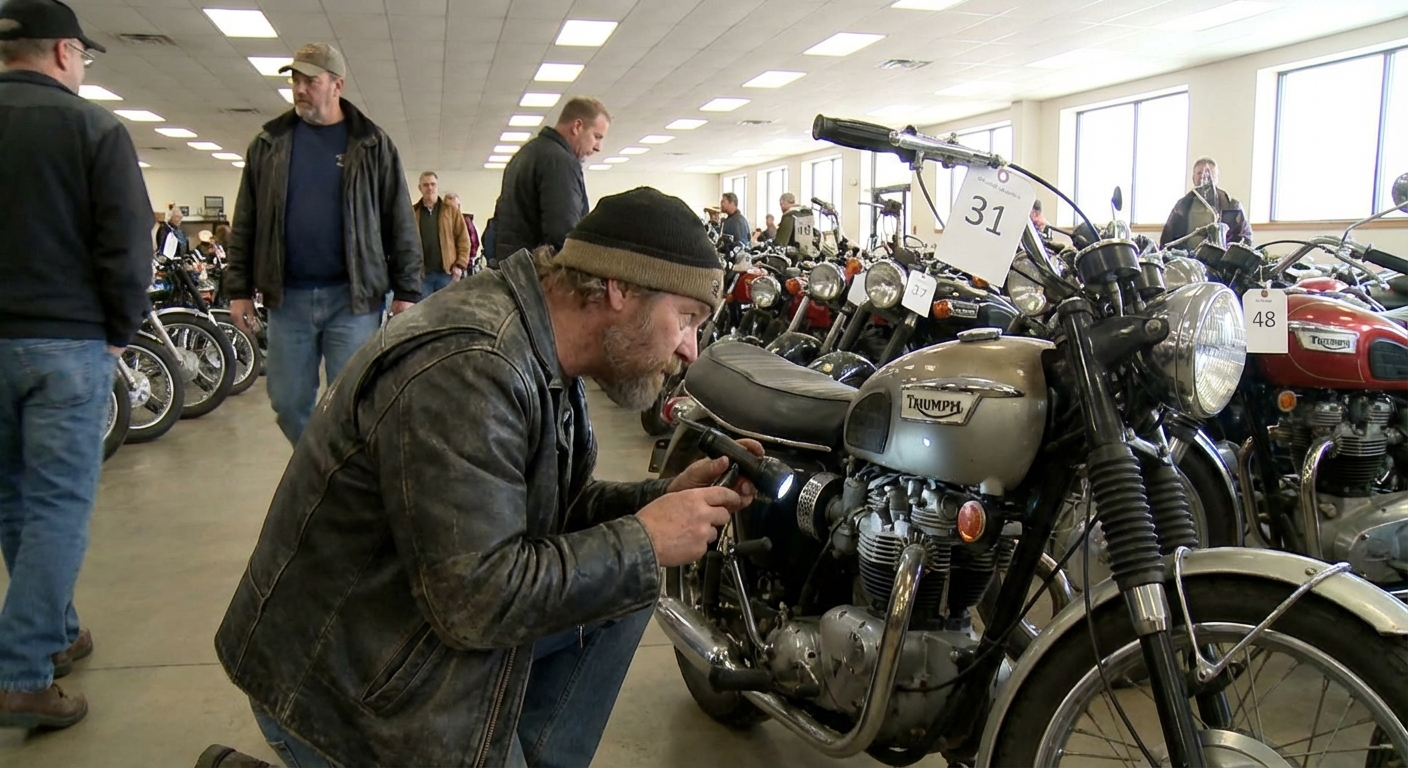
The Walk-Around: Visual Inspection That Actually Works
When I tested my current inspection routine against my old "just eyeball it" method, the difference was ridiculous. I walked away from three tempting bikes that would’ve cost me thousands in repairs.
Here’s how I walk a bike, step by step.
1. Start at the Front
- Forks & Suspension: Look for pitting, oil weeping, or slightly bent forks (stand in front and sight down them). Any leak around the fork seals means a rebuild.
- Front wheel & tire: Check tread depth, uneven wear, sidewall cracks, date code (I try to avoid tires older than 5–6 years). Spin the wheel (if allowed) and listen for bearing noise.
- Brake discs & calipers: Deep grooves, blueing, or lips on the disc edge mean heavy wear. Squeeze the lever—does it feel firm or spongy?
2. Move Along the Sides
I always get down low—auctions are where vanity meets reality.
- Frame: Look closely at welds, down tubes, and around the steering head. Any ripple in the paint, unusual welds, or kinks are a massive red flag. I once found a "straight" frame that had a hairline crack near the steering head. Walked away, someone else paid strong money for it.
- Controls: Check levers, footpegs, and bar ends. Scuffed bar ends and mismatched levers often scream "crash" even if the plastics look clean.
- Bodywork: Mismatched paint, DIY stickers hiding scrapes, or aftermarket fairings on one side only usually mean it’s been down.
3. Engine & Drivetrain
- Oil leaks: Look around gaskets, clutch cover, valve cover, and sump plug.
- Fasteners: Rounded bolts and half-stripped heads suggest ham-fisted maintenance.
- Chain & sprockets: Excessive rust, seized links, or hooked teeth = neglect.
- Radiator & hoses: Bent fins, seeping coolant, cracked hoses all add up.
4. Electrics & Instruments
If the auction allows battery hookup or brief startup:
- Check all lights, dash, and switches
- Watch for error codes or warning lights on modern bikes
- Flip the bars full lock and see if the engine stutters (sign of broken wiring at the headstock)
Engine Evaluation: The 60-Second Diagnosis
Not every auction lets you start bikes, but when they do, use those seconds wisely. In my experience, this is where your ears save your wallet.
Cold Start Behavior
If the engine’s already warm, I get suspicious. I like to:
- Touch the headers carefully (or hover a hand nearby) to see if they’re hot
- Listen to how it turns over—slow cranking can mean a weak battery or compression issues
On startup, listen for:
- Top-end ticking – Could be valve clearances or cam chain
- Deep knocking – Potential bottom-end wear, which is expensive
- Exhaust smoke:
- Blue: usually burning oil
- White: possible coolant in combustion (head gasket)
- Black: running rich
I once passed on a cheap V-twin that puffed blue smoke just on throttle blips. Turned out later (auction mechanic confirmed) it had ring issues and would’ve needed a full top-end rebuild.
Throttle Response
Gently blip the throttle:
- Does it hesitate or bog down?
- Does it hang at higher RPM before dropping?
These can indicate fueling or air leaks. EFI bikes can sometimes be sorted with a tune; carb bikes might need a full strip and clean.
Paperwork, VINs, and Title Nightmares
The least sexy part of buying at auction is also the most critical.
Check the VIN Properly
I always:
- Compare the frame VIN with the engine number and documentation
- Look for grinding, restamping, or dodgy tampering marks
A mismatched or obviously altered VIN is a hard pass for me… no matter how pretty the bike looks.
Title Status & History
If you’re in the U.S. or any country with branded titles, check whether it’s:
- Clean
- Salvage
- Rebuilt / reconstructed
In the U.S., you can check history via tools like the National Motor Vehicle Title Information System (NMVTIS) and Carfax or similar moto-specific services. Salvage and rebuilt titles can dramatically reduce resale value—sometimes by 20–40%.
I once grabbed a perfect-looking commuter bike, only to find out it had a flood-damage history in another state. It ran fine, but the corroded connectors came back to haunt me six months later.
Strategy: Bidding Without Getting Burned
The biggest mistake I see at auctions? People fall in love with a bike before the bidding starts.
Set a Hard Ceiling Price
Before the first lot rolls up, I write my max bid on my catalog next to each bike I’m interested in. Not "rough idea"—a number.
I base it on:
- Market value (clean, private sale)
- Visible issues and estimated repair costs
- Auction fees, taxes, transport
If bidding goes past that number, I let it go. The next bargain will come; the next financial regret is much harder to fix.
Avoid the Hero Complex
I’ve watched people get into ego battles:
> "He’s not outbidding me on that Ducati."
> 30 seconds later, they’ve overpaid by 25%.
The bike doesn’t know who owns it. It’s not judging you.
Factor in the Hidden Costs
In my experience, the real cost of an auction bike is:
> Final bid + buyer’s premium + tax + title/registration fees + transport + immediate maintenance.
That "steal" can quietly become near retail.
When You Shouldn’t Buy
Here are the signs I treat as near deal-breakers unless I’m buying strictly for parts:
- No paperwork and no clear path to getting it
- Major frame damage or questionable VIN
- Engine noise that suggests bottom-end failure
- Severe electrical hack jobs (melted wiring, random household connectors)
I’ve learned the hard way that cheap and good rarely show up in the same lot. When something feels off, I walk.
The Upside: Why Auctions Can Still Be Amazing
It’s not all doom and drama. When you approach it systematically, auctions can be:
- A way to access models that are rare in normal retail
- A goldmine for project bikes and track builds
- A smart route for flippers who know how to value repairs and parts
One of my favorite wins was a slightly rough adventure bike with cosmetic damage and a bent crash bar. Everyone else ignored it because it looked tired. I had checked the frame, suspension, and engine carefully—mechanically it was solid. After a weekend of cleaning, a new crash bar, and a service, I sold it three months later for a 35% margin.
That’s the real power of a solid evaluation process.
If you treat auctions less like a casino and more like a very time-limited inspection opportunity, you’ll start seeing what others miss—and avoid the bikes that look good only under the auction house lights.
Sources
- National Highway Traffic Safety Administration (NHTSA) – Vehicle Title and Salvage Information - Overview of title and salvage considerations in the U.S.
- U.S. General Services Administration (GSA) – Auctions - Official information on government vehicle auctions and processes
- Edmunds – How to Buy a Used Motorcycle - General checklist and valuation tips for used motorcycles
- Consumer Reports – Guide to Buying a Used Motorcycle - Expert advice on inspections and common issues in used bikes
- Kelley Blue Book (KBB) Motorcycles - Pricing and valuation reference for used motorcycles