Guide to Organizing Camper Vans Efficiently
over. That’s when I realized: organizing a camper van isn’t about fitting everything in — it’s about making everything stupidly easy to find and use.
Over the last few years, I’ve rented, borrowed, and eventually bought my own camper van. I’ve tested packing cubes that exploded zippers, magnetic strips that dropped knives at 2 a.m., and storage bins that turned into avalanches. What I’m sharing here is the stuff that actually works in real-life, stop-and-go, bumpy-road van life.
Start With Zones, Not Stuff
When I first started organizing, I did it wrong: I focused on things instead of zones. I tried to find a place for every item individually. Chaos.
What finally worked was dividing the van into clear zones, like a tiny apartment:
- Kitchen zone – cooking gear, food, dishes
- Sleep zone – bedding, pajamas, nighttime essentials
- Work/relax zone – electronics, books, chargers
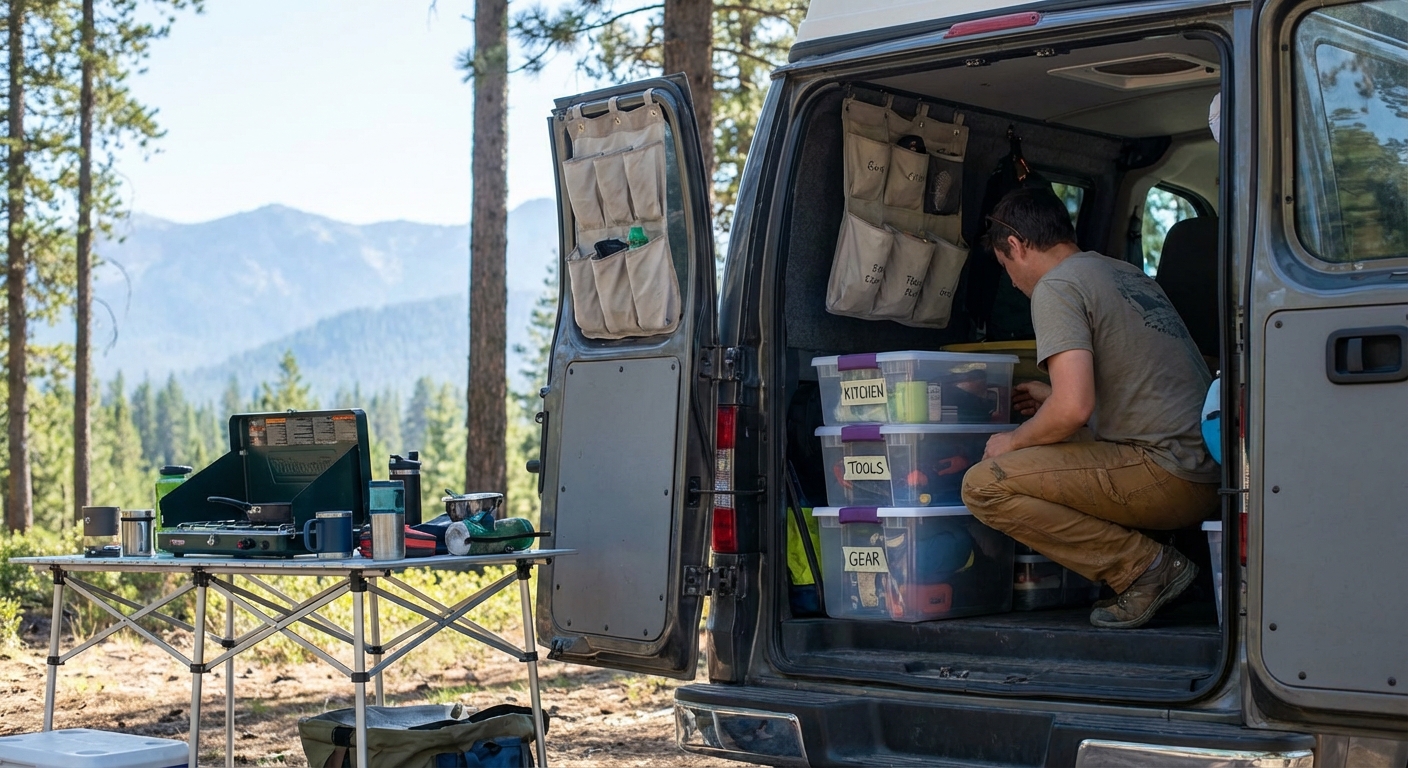
- Garage zone (usually the back) – tools, camp chairs, bulky gear
When I tested this zone approach on a 10-day road trip through Colorado and Utah, I noticed I stopped asking myself, “Where should this go?” and started asking, “Which zone does this belong in?” The difference in mental load was massive.
Pro tip from experience: tape temporary labels inside cabinets for your first trip. I literally wrote with painter’s tape: “dry food,” “cookware,” “toiletries”. It feels overkill, but after a long hike when your brain is fried, future-you will say thank you.
Use Vertical Space Like a Tiny-Home Pro
Most camper vans have one big problem: wasted vertical space. Cabinets are tall, but everything piles at the bottom.
What’s worked best for me:
1. Soft Bins and Packing Cubes
I recently discovered that soft-sided bins are absolute game-changers for overhead cabinets. Hard plastic bins waste space because they can’t flex into odd corners. I use soft fabric bins or packing cubes for:
- Breakfast items
- Snacks
- Dinner ingredients
- Coffee/tea kit
On my last trip, I labeled each cube with a cheap fabric tag and a Sharpie. Suddenly, “Where’s the coffee?” turned into “Grab the cube that says COFFEE.” It shaved real time off morning chaos.
2. Shelf Risers and Inserts
If your van has tall cabinets, those wire shelf risers you see in kitchen organization videos actually work great in vans. I tested basic stackable shelf inserts from IKEA in my galley and doubled the usable space for plates and bowls.
The only catch: you need to secure them. I used industrial-strength Velcro on the base to stop them from sliding while driving. Without that, they turned into little metal projectiles on a rough forest service road.
The “One-Action” Rule for High-Use Items
In my experience, the biggest difference between a comfy van and an irritating one is how many actions it takes to access the stuff you use every day.
I use what I call the one-action rule:
> Anything I use repeatedly every day must require only one action to access.
That means:
- Toothbrush? In a cup or hanging caddy, not zipped in a bag.
- Coffee mug? On a hook or open shelf, not buried behind four other things.
- Headlamp? On a magnet or specific hook by the door.
When I ignored this and kept my cooking oil in a zipper bag, I had to dig it out every single meal. Once I moved it to a dedicated cubby by the stove, cooking felt smoother and faster.
Think about your personal “high-traffic” items: phone, keys, jacket, water bottle, headlamp, sunglasses. Give each of them a permanent, one-step home right by the door or kitchenette.
Smart Storage Solutions That Actually Survive the Road
I’ve tried a lot of viral organization hacks. Some were brilliant; some were pretty on Instagram and terrible in a moving vehicle.
Here’s what’s consistently worked well while driving:
Over-the-Door and Seat-Back Organizers
I tested a cheap over-the-seat organizer behind the passenger seat for:
- Maps
- Notebooks
- Chargers
- Sunscreen
- Bug spray
It turned that usually-wasted vertical area into prime storage. Bonus: everything’s accessible from the front seats during long drives.
Drawer Dividers and Anti-Slip Mats
If your van has drawers, internal chaos happens fast. I use:
- Expandable drawer dividers for utensils and tools
- Anti-slip rubber mats so things don’t slide and clatter
There’s some backing for this approach: RV and van conversion companies (like Winnebago and Storyteller Overland) commonly use lined drawers and built-in dividers for noise reduction and item protection — because constant vibration wears gear out faster than you’d think.
Hooks, Magnets, and Rails (With Caution)
I love hooks and rail systems — they’re like cheat codes for vertical storage. I hang:
- Jackets and hats on wall hooks near the door
- Dish towels on a rail by the sink
- Keys on a dedicated hook so they never get “lost in the van”
Magnets can be great for spice tins or lightweight metal items. When I tested a magnetic knife strip though, it failed on rough gravel roads — knives slid off twice. I switched to a sheath + drawer combo. Less aesthetic, more safe.
Food and Kitchen: Where Organization Matters Most
The kitchen is where I’ve made the most mistakes and improvements.
Categorize by Use, Not by Type
Instead of storing all spices together and all dry goods together, I started organizing by meal kit:
- “Breakfast box” – oats, coffee, tea, sugar, peanut butter
- “Dinner base” – rice/pasta, oil, spices, garlic
- “Quick grab” snacks – bars, nuts, dried fruit in a dedicated bin near the door
This “kit” style is similar to how expedition teams and overlanding guides organize for multi-day trips. It speeds up cooking and makes inventory checks simpler — I can see if the breakfast box looks sad and needs a grocery run.
Avoid the Giant Pantry Black Hole
Deep cabinets become food graveyards. I use:
- Shallow bins or baskets so nothing gets buried
- FIFO (first in, first out) rotation — new food goes to the back, old to the front
A 2020 study from the USDA estimated that 30–40% of the US food supply is wasted, much of it due to poor storage and forgetting what you have. Vans magnify that problem because space is small and access isn’t straightforward.
I’ve thrown out too many stale crackers and mystery pasta bags. Clear containers and shallow bins have almost eliminated that.
Clothes: The Battle Against the Backpack Explosion
If you let clothes live in a backpack, they will end up in a heaping pile on the bed. Ask me how I know.
What’s worked best for me:
- One packing cube per category: tops, bottoms, underwear/socks, “funky/dirty but re-wearable”
- A very small “lounge/sleep” cube that lives near the bed
At night, I don’t want to dig through my whole wardrobe. I grab the sleep cube and I’m done.
I tried rolling clothes vs folding. Rolling saves a bit more space, but honestly, the bigger win is consistency. Pick one method and stick with it. The real organizing power is knowing exactly what lives where.
The Garage Zone: Bulky Gear Without the Tangle
The rear “garage” area (under the bed in many builds) tends to become the van’s junk drawer — chairs, tools, hoses, random camp stuff.
What finally tamed mine:
- A three-bin system:
- Bin 1: camp comfort (chairs, table, hammock)
- Bin 2: tools and maintenance (basic tool roll, tape, fuses, fluids)
- Bin 3: utilities (water hose, power cable, leveling blocks)
- A labeled tool roll for the essentials: multi-bit screwdriver, pliers, adjustable wrench, hex keys, zip ties, duct tape. I copied that from a friend who’s a mechanic; he laughed when he saw my old “tool box of shame.”
I also keep a small, separate emergency grab kit by the rear door: first aid, headlamp, multi-tool, small tarp. I hope I never need it in a hurry, but if I do, I don’t want to dig.
Weight Distribution and Safety: The Boring Stuff That Actually Matters
When I started out, I didn’t think about weight distribution much. Then I read Mercedes-Benz’s guidance for Sprinter upfitters and realized how easy it is to overload one side or the rear.
From my experience — and from what vehicle manufacturers and RV safety organizations recommend — a few rules are worth following:
- Keep heavy items low and centered (water, tools, batteries)
- Don’t overload rear doors or high cabinets with dense gear
- Secure everything that could become a projectile in a crash or sudden stop
The National Highway Traffic Safety Administration (NHTSA) has long emphasized the dangers of loose objects in vehicles; even a 2-pound item can hit with dramatic force in a collision. I’ve felt this play out on a smaller scale just slamming the brakes — the noise of loose cookware flying forward is… motivating.
So now, I:
- Use latches on every cabinet and drawer
- Add bungee cords or straps in the garage zone
- Avoid stacking heavy bins on high shelves, no matter how tempting
Living With Your System: Adjust, Don’t Overperfect
Here’s the honest part: no organizing system survives first contact with real life exactly as planned.
On a three-week trip, I realized my “work stuff” was in the wrong place. My laptop and notebook were buried in an overhead bin that required standing on the step to reach. After two days, I moved them to a soft sleeve that slid under the bench seat. Problem solved.
What I do now:
- Set up a logical first-pass system.
- Take one or two trips.
- After the trip, write down:
- What I never used
- What I could never find
- What annoyed me every single day
- Reorganize based on reality, not the Pinterest version.
Van organization is less about one perfect layout and more about iterating until your van matches how you personally live, cook, work, and relax.
And honestly, when it all clicks — when you pull into camp at 9 p.m., pop open two cabinets, and have bed and dinner ready in minutes — the feeling is addictive.
Sources
- NHTSA – Vehicle Loading and Tire Safety - Government guidance on safe loading and loose cargo
- USDA – Food Waste FAQs - Data on food loss and waste in the United States
- Mercedes-Benz Sprinter – Body and Equipment Guidelines - Manufacturer guidance for upfitting and loading (see technical documentation section)
- Winnebago – Van-Based RV Floorplans & Storage - Examples of professional storage and layout strategies
- Storyteller Overland – Van Layouts & Gear Storage - Real-world garage, kitchen, and interior storage design ideas