Guide to Practical Camper Van Accessories Explained
On my first proper trip in a self-built camper, I packed three different camp stoves, a folding bucket I never unfolded, and a so-called “must-have” gadget that claimed it could charge a laptop with sunlight the size of a postcard. Spoiler: it couldn’t.
Over the next few years, driving everything from a rented VW California to a DIY Transit build, I’ve slowly figured out which camper van accessories actually pull their weight—and which just look pretty on Instagram. This guide is my filtered, road-tested list: the things that genuinely make van life easier, safer, and more comfortable.
The Golden Rule: Accessories Must Earn Their Space
When I started, I had this fantasy that I could bring everything “just in case”. Then I tried living in 60 square feet with a bulky espresso machine and three crates of “maybe useful” gear.
Now I use a simple rule: if an accessory doesn’t do at least one of these, it goes:
- Saves time or hassle daily
- Increases safety or reliability
- Cuts down other gear (multi-use)
- Improves sleep or comfort significantly
With that in mind, here are the categories where the right accessories actually matter.
Power & Electricity: The Non-Negotiable Foundation
When I tested a week-long trip running only on my van’s starter battery and a cheap inverter, it ended with a jump-start from a very amused farmer. Since then, power planning is the first thing I talk about.
1. Portable Power Stations & Batteries
I’ve used both a fixed lithium house battery system and an all-in-one power station (Jackery and EcoFlow, mainly). For most people starting out, a 500–1000Wh power station is the most practical accessory you can buy.
Why it’s useful- Plug-and-play: built‑in inverter, MPPT solar controller, display
- Safer and simpler than DIY electrics
- Can move between van, tent, and house during outages
- 500Wh is fine for weekend trips (phones, lights, cameras)
- 1000Wh+ is better for laptops, fans, and a 12V fridge
- Fast charging from the alternator or solar is a real game changer for off-grid stays
The U.S. Department of Energy has a nice breakdown of appliance energy use that helped me size my setup realistically, instead of guessing and praying.[¹]
2. Solar Panels (Suitcase vs. Roof-Mounted)
I started with a fixed 200W rooftop panel and later added a 100W folding suitcase panel. If I had to pick one for beginners: a 100–200W folding solar suitcase wins on practicality.
Pros (from real use):- You can park the van in shade and put the panel in the sun
- Easy to stow when not needed
- Great for renters or those who don’t want to drill into the roof
- You have to remember to set it up
- Takes up storage space
Roof panels are fantastic for full-timers, but for many occasional campers, portable solar is a more flexible first step.
Sleep & Comfort: The Accessories That Decide If You’ll Keep Doing This
The first time I tried sleeping on the stock bench seat of a rental van with a thin foam topper, I woke up feeling like I’d gone three rounds with a parking bollard. Upgrading sleep gear changed everything.
3. A Real Mattress (Or a Smart Hack)
I eventually cut a 4-inch high-density foam mattress to fit my bed platform and wrapped it in a washable cover. That’s still one of the best upgrades I’ve ever made.
Why it’s worth the space- Consistent sleep quality = actual energy for hiking, driving, and existing
- You’re more likely to keep using the van long-term
4. Blackout & Thermal Window Covers
When I tested my first DIY window covers made from Reflectix and duct tape, they looked like a failed art project—but the temperature difference was real.
Well-made magnetic or custom-fit covers do three things:
- Block light for stealth camping in cities
- Reduce heat gain in summer and heat loss in winter
- Add privacy (no more waking up to a dog staring straight into your soul)
In cold conditions, the difference with and without proper covers is dramatic. The National Renewable Energy Laboratory has repeatedly shown how much heat is lost through windows in small spaces—window insulation matters way more than most new van owners think.[²]
Kitchen & Cooking: From Chaos to “I Can Actually Find the Salt”
My first van kitchen was… let’s say optimistic. I had a big two‑burner stove, two pots, three pans, and exactly zero organization. Cooking took 20 minutes while finding things took 15.
5. A Reliable Dual-Fuel Stove
After flings with alcohol stoves and cheap butane burners, I settled on a simple dual-fuel setup: a butane stove for quick cooking and a backup propane or multi-fuel option for colder temperatures.
Why dual-fuel is practical- Butane struggles in colder weather; propane handles it better
- Having two fuel options has saved more than one trip
If you plan to cook indoors, follow manufacturer ventilation guidelines obsessively. The CDC has clear warnings about carbon monoxide risks with fuel-burning appliances in enclosed spaces.[³]
6. Collapsible Cookware & Stackable Containers
When I tested collapsible silicone bowls and pots, I was skeptical. I expected floppy, half-melted disasters. Some cheap ones were terrible, but good-quality collapsible gear + nesting pots freed up an entire cabinet in my van.
My current kitchen MVPs:
- One deep non-stick pan with lid (does 80% of my meals)
- Collapsible strainer
- Stackable, leakproof food containers
The hidden benefit? Less rattling while driving and way faster cleanup.
Storage & Organization: The Boring Stuff That Makes Life Actually Work
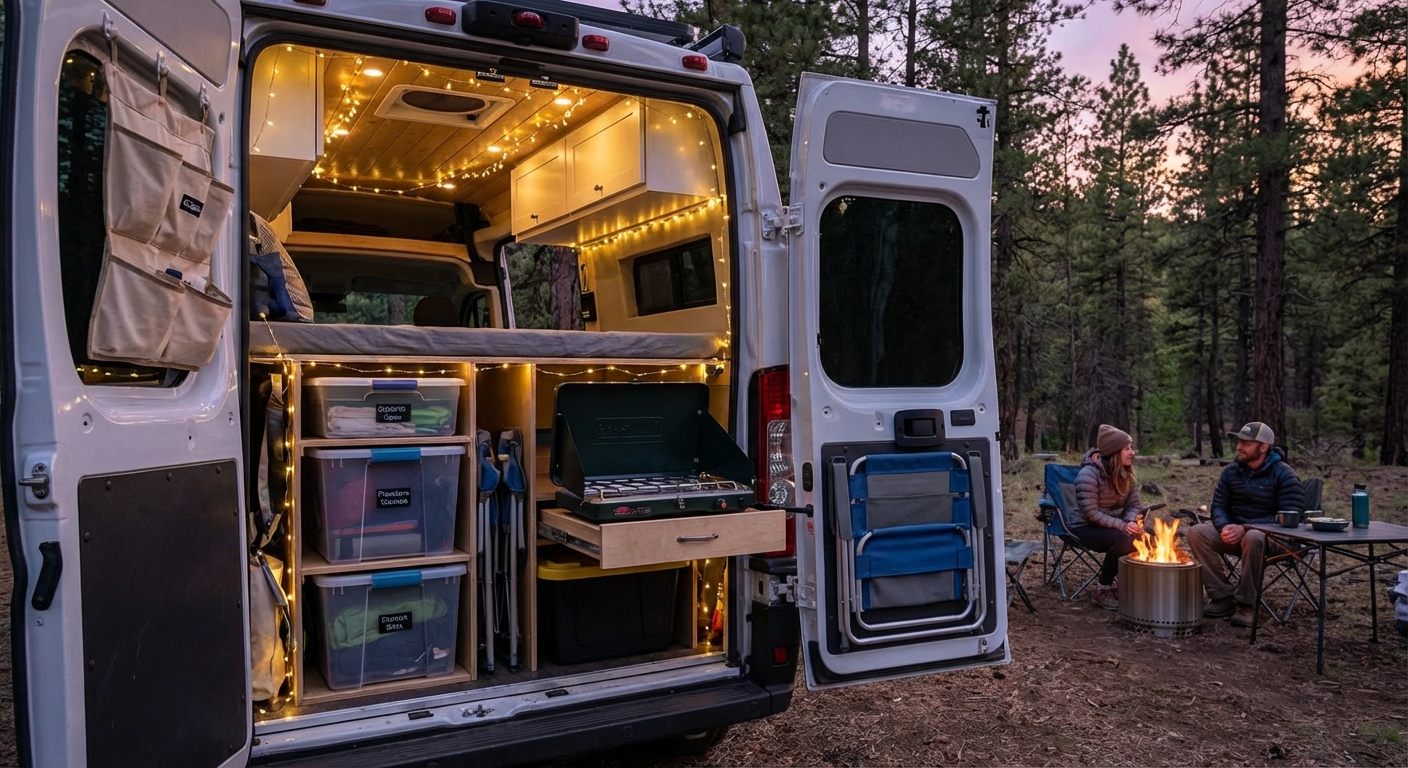
I used to think packing cubes and labeled bins were for people who alphabetize their spice racks. Then I spent 10 minutes hunting for my headlamp in a dark forest parking lot. I converted.
7. Soft Storage Cubes & Overhead Nets
Hard bins are great for garages; soft cubes are friendlier in tiny moving spaces.
What worked well for me:
- One cube for “morning stuff” (toothbrush, meds, deodorant)
- One for tech (cables, chargers, power bank)
- One for “bedtime” (eye mask, earplugs, book)
Overhead cargo nets above the bed are surprisingly useful for jackets, hats, and that one hoodie you keep wearing.
8. A Simple “Drop Zone” Near the Door
When I added a shallow basket by the sliding door for keys, wallet, and sunglasses, my daily stress dropped by about 20%. It’s such a small accessory, but it stops that panicked “where’s my…?” spiral every time you move spots.
Water, Hygiene & Staying (Reasonably) Human
I once tried a four-day trip without any real water system—just a couple of 1.5L bottles. By day three, I was doing very creative math with how much I could use to brush my teeth.
9. Stackable Water Containers (10–20L)
I’ve tested built-in tanks and simple portable jugs. For most people, especially renters, two 10L stackable containers with proper spigots are the sweet spot.
Pros from real trips:
- Easy to carry to a tap or station
- One “dirty” (for dishes, rinsing), one “clean” (for drinking)
- Lower risk of contamination vs. one giant tank you never fully drain
The EPA’s drinking water safety guidelines are a good reference if you’re filling up from public taps or campgrounds.[⁴]
10. A Real-ish Shower Solution
I’ve tried:
- Solar bag showers (lukewarm, gravity-fed, awkward)
- Pressurized camp showers (better pressure, more setup)
- Gym memberships and truck-stop showers (most comfortable, not always nearby)
My practical compromise:
- Pressurized 5–7L camp shower +
- Microfiber towel +
- A cheap floor tray or outdoor mat
Is it spa-level luxury? No. But it beats feeling like a swamp goblin on day five.
Safety & Recovery: The Stuff You Hope You’ll Never Need
On a dirt road in the Lake District, I managed to bury my front wheels in wet grass. No signal, light rain, and fading daylight. The accessory that saved me wasn’t glamorous: a compact traction board.
11. Basic Recovery Kit
What’s actually been useful in real stuck moments:
- Compact traction boards (the smaller, honeycomb-style ones)
- Folding shovel
- Tow strap with proper rating (check your van’s GVWR)
If you’re curious how professionals think about vehicle recovery, the UK’s AA and the U.S. AAA both have surprisingly practical online guides.
12. First Aid & Fire Safety
These aren’t “nice-to-haves”, they’re non-negotiable:
- Medium-sized first-aid kit you actually know how to use
- 1 or 2 small ABC dry powder fire extinguishers
- Fire blanket near the cooking area
NFPA (National Fire Protection Association) data on small-space fires made me take this more seriously—van + fuel + electrics + cooking is a spicy combination when things go wrong.[⁵]
Tech & Navigation: Helpful, Until It Isn’t
I love gadgets, so I’ve definitely overdone it here. Some tech, though, has earned permanent residency in my van.
13. Phone Mount & Offline Navigation
A rock-solid phone mount + offline maps (Google Maps offline areas, or apps like Gaia GPS) have saved my sanity more than once when 4G disappeared.
But I still keep an old-school paper road atlas as backup. Once, in rural Wales, every app insisted a locked farm gate was a public road. The paper map, clearly, disagreed.
14. 12V Fan vs. Portable Heater
When I tested a low-draw 12V fan during a summer trip, the perceived comfort jump was huge. In winter, I experimented with a portable propane heater and immediately understood why so many experienced van owners warn about them.
My take:- 12V fan? Incredibly practical, low-risk, easy win.
- Portable combustion heater inside the van? Only with serious ventilation, CO detector, and a clear understanding of the risks.
For most people, I’d prioritize good bedding, thermal covers, and maybe an electric blanket (if your power system can handle it) over a combustion heater as an early accessory.
What I’d Actually Buy First (If I Were Starting Again)
If I had to strip everything back and start from scratch, these would be my first practical purchases:
- 800–1000Wh portable power station + cables for alternator and solar
- 100–200W folding solar panel
- Good foam mattress cut to size
- Blackout/thermal window covers
- Butane or dual-fuel stove + one pan, one pot
- Two 10L water containers with spigots
- Basic safety kit (first-aid, extinguisher, traction boards)
Everything after that is refinement.
Some accessories look cool on social media but never leave the storage bin. Others—like a dull-looking water jug or a boring mattress—quietly make every single day on the road better. The trick, at least in my experience, is learning to tell the difference before you spend half your budget on “maybe one day” gadgets.
And if you’re unsure whether something is practical or just shiny? Leave it at home for the first trip. If you catch yourself saying, “I really wish I had…”, then you’ve found your next accessory.
Sources
- U.S. Department of Energy – Estimating Appliance and Home Electronic Energy Use - Reference for realistic power consumption and sizing batteries/solar.
- National Renewable Energy Laboratory (NREL) – Windows and Building Envelope Research - Data on heat gain/loss through glazing, relevant to window insulation.
- Centers for Disease Control and Prevention – Carbon Monoxide Poisoning Prevention - Guidance on safe use of fuel-burning devices in enclosed spaces.
- U.S. Environmental Protection Agency – Drinking Water Information - Safe drinking water practices when filling van tanks and containers.
- National Fire Protection Association (NFPA) – Home Heating Safety - Principles for safely using heaters and managing fire risk in small spaces.