Guide to the Toyota RAV4 Market and Pricing
at every car nerd does: checking used prices, scrolling listings at midnight, and saying, “Wait… why are these holding value this well?”
If you’re trying to figure out whether a RAV4 is worth the money right now—and what a fair price even is—this guide will save you a lot of tab-hopping.
Why the RAV4 Market Is So Competitive
When I tested a 2023 RAV4 Hybrid for a few days, what struck me wasn’t that it was exciting (it’s not) but that it just quietly does everything right: decent power, great fuel economy, roomy interior, and Toyota reliability baked in.
From a market perspective, it sits in the sweet spot of the compact SUV segment:
- Practical daily driver
- Crossover-style ride height
- Mainstream brand trust
That combo has created stubborn demand.
A quick snapshot of its popularity
- The RAV4 has been one of the best‑selling SUVs in the U.S. for years. In 2023 it was again near the top of U.S. light vehicle sales, according to data reported by Toyota and covered in outlets like Forbes and CNN.
- It competes with the Honda CR‑V, Mazda CX‑5/CX‑50, Hyundai Tucson, Kia Sportage, Nissan Rogue, and Subaru Forester.
When I started price‑shopping, I noticed something: even RAV4s with 80,000+ miles were regularly listed only a few thousand dollars under newer, lower‑mileage rivals. That’s the used market quietly voting with its wallet on long‑term reliability and demand.
New Toyota RAV4 Pricing: What You Actually Pay
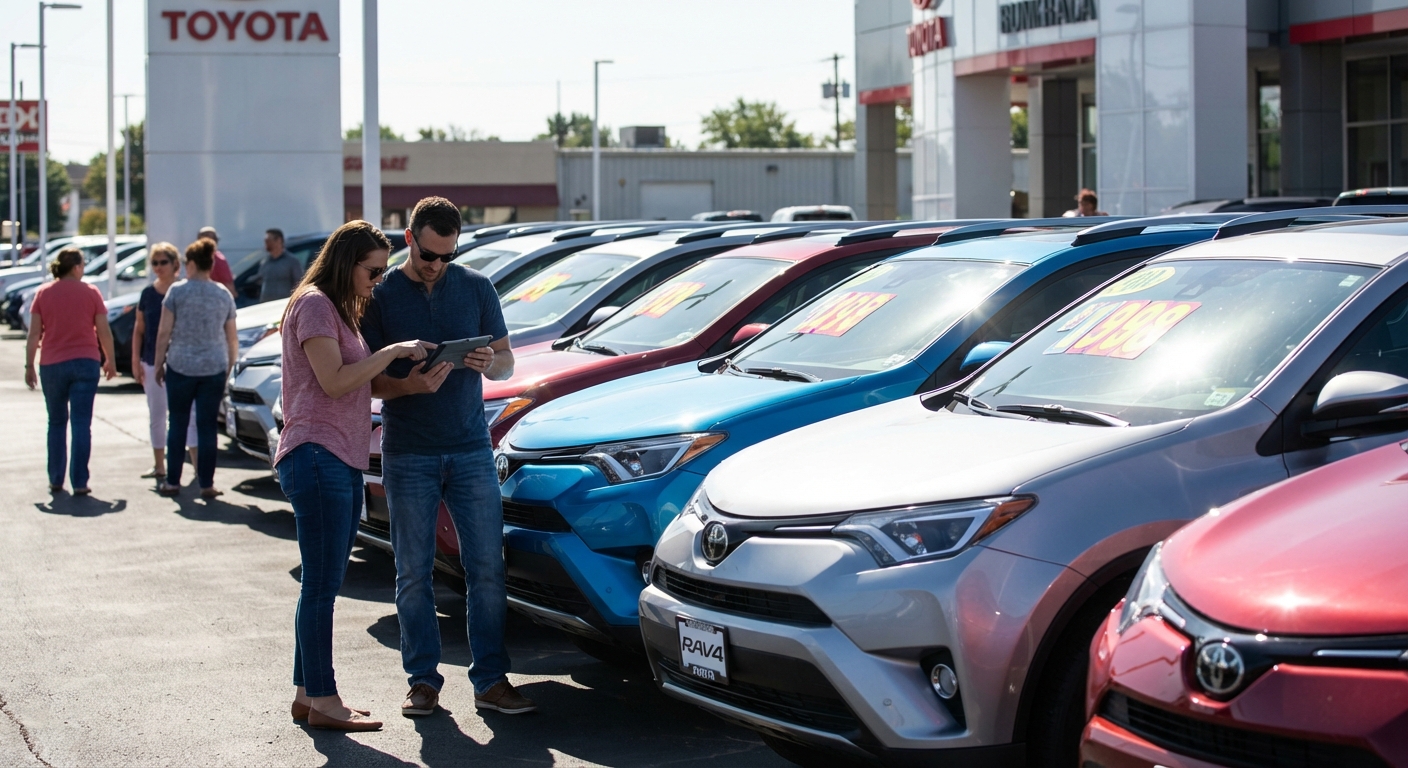
MSRP is just the starting line. When I went to a local dealer to test a RAV4 XLE and an XSE Hybrid, the salesperson slid a worksheet across the desk that looked nothing like the nice clean price Toyota shows on its site.
Base MSRPs (approximate, U.S.)
As of late 2024, Toyota’s own pricing (always check their site for the latest numbers) typically lands around:
- RAV4 LE (gas) – low $30,000s
- RAV4 XLE / XLE Premium – mid $30,000s
- RAV4 Adventure / TRD Off‑Road – upper $30,000s to low $40,000s
- RAV4 Hybrid (LE/XLE/XSE/Limited) – roughly $1,500–$3,000 more than equivalent gas trims
- RAV4 Prime (plug‑in hybrid) – often mid to high $40,000s before incentives
Those numbers swing a bit with destination fees, options, and regional adjustments, but that’s roughly the playground.
Why your “real” price is usually higher
When I asked for an out‑the‑door quote, the trim-level price was just one line. Others included:
- Destination and handling (non‑negotiable)
- Dealer doc fees (semi‑negotiable, depends on state laws)
- Add‑ons like paint protection, nitrogen tires, VIN etching, and window tint (very negotiable—sometimes pure margin)
On one RAV4 XLE Hybrid, the add‑ons alone were over $1,800. When I pushed back, about half of that “magically” disappeared. That’s the game.
RAV4 Prime: A pricing beast of its own
The plug‑in RAV4 Prime is where I really saw market distortion.
When I was cross‑shopping plug‑ins, I noticed RAV4 Primes listed several thousand over MSRP in some high‑demand markets, even used. Why?
- Strong demand + limited allocation
- 42‑ish miles of electric range (solid for a PHEV SUV)
- Hybrid + EV tax incentive history (some incentives have changed, so always check current federal and state rules)
If you’re eyeing a Prime, be prepared for:
- Long wait lists in some regions
- Less negotiation room
- A higher baseline price—but lower running costs if you charge regularly at home
Used RAV4 Pricing: Why It’s So Sticky
When I really dove into the used market—AutoTrader, CarGurus, Facebook Marketplace—I had that moment of, “Wow, these are proud of their miles.”
Typical used price bands (very rough, U.S.)
These are ballpark ranges I kept seeing across multiple listing sites:
- 2016–2018 (gas): often around $16,000–$24,000 depending on mileage and trim
- 2019–2020 (new generation): roughly $23,000–$30,000
- 2021–2023 gas: many in the $27,000–$34,000 range
- Hybrid models: often $1,500–$4,000 more than similar gas models
Actual prices depend heavily on:
- Mileage
- Accident history (pull a Carfax or AutoCheck)
- Trim and AWD vs FWD
- Local supply/demand
In my experience, metro areas with strong outdoor culture (think Pacific Northwest, Colorado, parts of the Northeast) often have slightly higher prices for clean RAV4s, especially AWD and Adventure/TRD trims.
Why used RAV4s hold value
A few underlying factors I kept bumping into as I researched:
- Reliability reputation – Toyota’s long track record, and data from sources like Consumer Reports and J.D. Power, feed buyer confidence.
- Demand for crossovers – Compact SUVs are the default family car now.
- Fleet and rental use – Tons of RAV4s in rental fleets make parts and service well‑understood, but you do need to watch for ex‑rental units.
- Fuel prices – When gas spikes, hybrids especially become hot commodities.
That combination keeps depreciation relatively shallow compared with some rivals.
RAV4 Trims, Engines, and How They Affect Price
When I was trying to decode why one used RAV4 was $4,000 more than another that looked identical in photos, it usually came down to three things: trim, drivetrain, and propulsion.
Gas vs Hybrid vs Prime
- Gas RAV4 – Cheapest to buy, simplest powertrain, still decent fuel economy.
- RAV4 Hybrid – Higher upfront price, but stellar real‑world mpg. On my highway test drive, I was easily seeing high 30s mpg.
- RAV4 Prime (PHEV) – Highest purchase price, but you can run most daily driving on electricity if you charge at home.
If you drive a lot of city miles or have a long commute, the Hybrid can make up its price premium surprisingly fast.
Trim levels that move the needle
In my search, these trims consistently priced higher on both new and used markets:
- XSE Hybrid – Sportier look, popular spec.
- Adventure / TRD Off‑Road – Rugged styling, higher towing, often higher demand in certain regions.
- Limited – Tech and comfort features push price up.
Base LEs were cheaper, but many shoppers (me included) tend to want at least XLE for better features and resale strength.
How to Tell If You’re Getting a Good Deal
When I was seriously considering making the leap, here’s the checklist I used to sanity‑check pricing.
1. Compare against multiple benchmarks
I cross‑referenced:
- Toyota’s official MSRP for the trim and options
- Third‑party pricing tools (Kelley Blue Book, Edmunds, etc.)
- Actual listings in my region for similar year/mileage
Once you’ve looked at 20‑30 listings, you start to get a feel for what’s “normal” versus inflated.
2. Focus on total cost, not just payment
One dealership tried really hard to sell me on a monthly payment. But buried in that was:
- A markup over MSRP
- Add‑ons I didn’t ask for
- A long loan term with extra interest
I always forced the conversation back to out‑the‑door price.
3. Time your purchase if you can
From my own experience and talking with sales managers:
- Month‑end and quarter‑end can bring more wiggle room as dealers chase sales targets.
- Incoming model year changeovers (fall typically) can create incentives on outgoing models.
Not magical, but it can shave off enough to make the research worth it.
Pros and Cons of Paying the “RAV4 Premium”
I’m not going to pretend the RAV4 is perfect. There are tradeoffs, especially at current prices.
Where paying more can make sense
In my experience, the RAV4 is worth the stronger pricing if you:
- Plan to keep it for 7–10+ years, leveraging reliability and resale
- Value fuel savings (Hybrid/Prime) and drive enough to benefit
- Want a known quantity with a huge service and parts network
You’re paying partially for predictability.
Where it might not be the best value
I’ve also seen cases where a RAV4 wasn’t the smart money move:
- If a Mazda CX‑5/CX‑50 or Hyundai Tucson is several thousand cheaper for similar features
- If you lease and flip often—resale value matters less
- If you want a softer ride or quieter cabin; some rivals do this better
The interior materials and NVH (noise, vibration, harshness) in the RAV4 are good but not luxurious; if you’re ultra‑sensitive to cabin refinement, you might find better value elsewhere.
Practical Tips Before You Buy
Here’s the distilled version of what actually helped me sort through the noise.
For new RAV4 shoppers
- Build your exact spec on Toyota’s website first, then compare that build to dealer inventory.
- Request line‑item quotes by email from multiple dealers, including out‑the‑door pricing.
- Push back on “mandatory” add‑ons. When I did, several suddenly became optional.
For used RAV4 shoppers
- Always run a vehicle history report.
- Get a pre‑purchase inspection—especially for high‑mileage or ex‑fleet units.
- Don’t be afraid of mileage if the maintenance history is solid; the RAV4 platform is designed to go long.
When I took a candidate to an independent mechanic, he pointed out minor suspension wear I’d have missed. That gave me negotiating leverage and probably saved me a few hundred dollars in surprise repairs.
If you’re patient, do a bit of homework, and keep your eyes on total cost rather than the hype, the RAV4 can absolutely be a smart buy—both as a daily driver and as a long‑term asset that doesn’t evaporate in value the minute you leave the lot.
Sources
- Toyota USA – RAV4 Models & Pricing – Official trims, features, and current MSRP ranges
- U.S. Bureau of Labor Statistics – Consumer Price Index: New and Used Vehicles – Data context on new and used vehicle pricing trends
- Consumer Reports – Toyota RAV4 Road Test & Reliability – Independent testing and long‑term reliability information
- Forbes – Best-Selling Cars And Trucks In America – Sales rankings and market position for the RAV4 and competitors
- Edmunds – Toyota RAV4 Pricing & Reviews – Real‑world transaction price data and ownership insights