The Night an AI Wrote a Song That Freaked Me Out
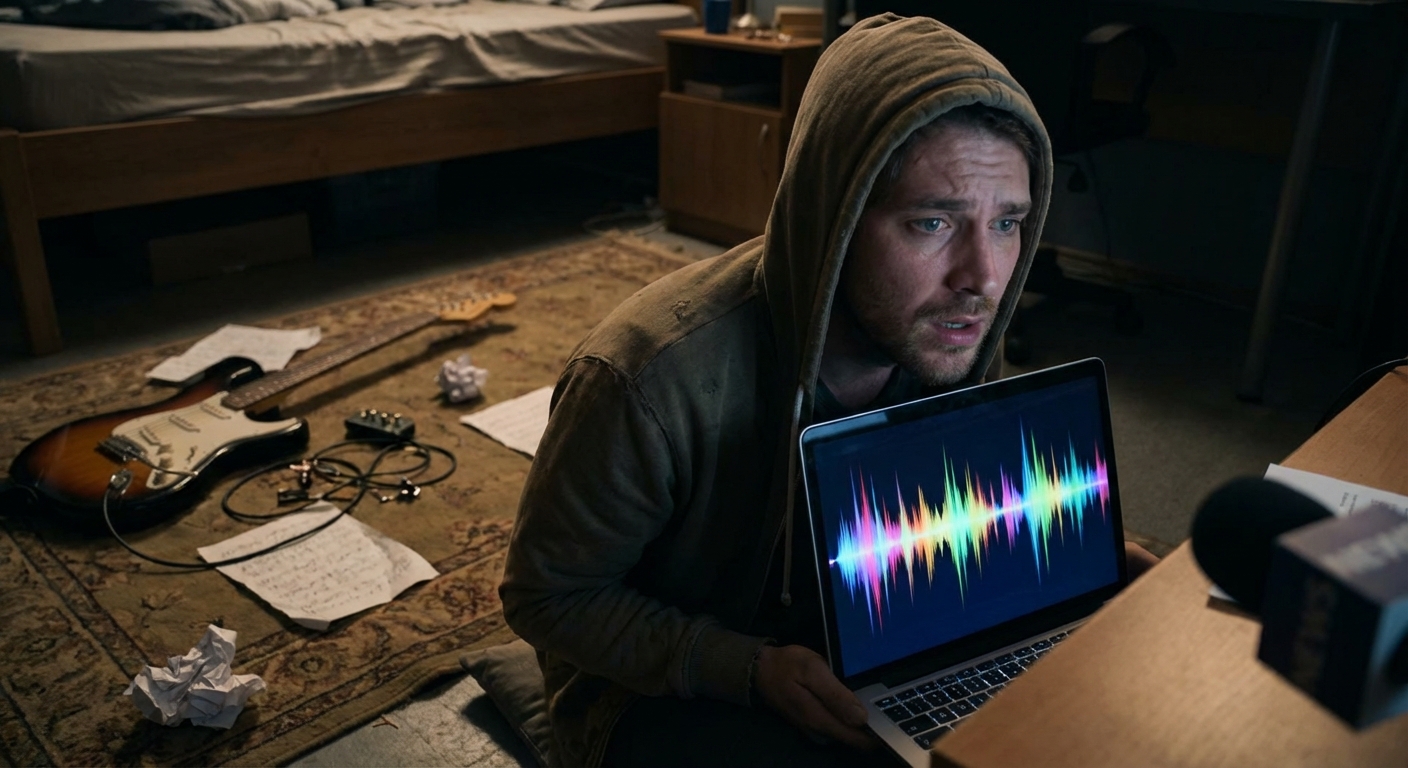
I was in my studio — which is honestly just a desk with an audio interface and a very judgmental plant — testing a new AI music tool called Suno. I typed in:
> “Melancholic pop ballad about growing up online, female vocal, subtle electronic production.”
Forty seconds later, it played me a fully produced track.
Verse, chorus, bridge. Lyrics that were… not terrible. A vocal that sounded strangely human, sitting on top of chords that would not be out of place in a Spotify "Chill Pop" playlist.
I just sat there, headphones on, slightly horrified.
I’ve been writing songs in various levels of seriousness for about ten years. I’ve spent nights obsessing over snare sounds. I’ve argued with friends about whether Max Martin is the quiet architect of modern pop (he is). And suddenly an AI model had just generated a complete, shareable song in less than a minute.
That night started a months‑long experiment where I pushed multiple AI music tools — from Suno and Udio to AIVA — to see what they can actually do, where they fall apart, and what all this means for real musicians.
How These AI Music Tools Actually Work (Without the Math Headache)
The short version: modern AI music tools use generative models trained on massive datasets of existing audio.
Systems like Google’s MusicLM (announced in a 2023 research paper) and Facebook’s MusicGen take a text prompt and generate new audio by predicting what sound should come next, frame by frame, based on everything they’ve learned from the training data.
Suno and Udio don’t publish all their technical details, but they’re in the same family of models: text‑to‑music systems that convert your description into embeddings (mathematical representations of style, mood, tempo, etc.) and then produce audio that matches those patterns.
In plain language: they’ve listened to more music than any single human ever could, analyzed it, and learned the statistical patterns behind chords, melodies, rhythms, and timbres.
That doesn’t mean they “understand” music emotionally. But they’re frighteningly good at imitating the surface of style.
What Happened When I Tried to Co‑Write With AI
After the initial shock, I stopped asking, “Is this good?” and started asking, “Is this useful?”
So I opened up a half‑finished track of mine — a guitar‑driven indie thing with a stuck chorus — and treated the AI like a very fast, very emotionless collaborator.
1. Lyric Experiments
I dumped my verse lyrics into ChatGPT (yes, I’m aware of the irony) and asked for five alternate chorus concepts that kept the same emotional core but changed the central metaphor.
Some options were cringe. Some were surprisingly sharp. One line — “we grew up in loading screens, learned love through latency” — made me laugh and then stay. I kept it.
There’s actually some academic backing for this kind of use. A 2021 study presented at the International Conference on Computational Creativity found that writers using AI as a prompt generator reported higher perceived originality, even when they heavily edited the suggestions.
I felt that: the AI wasn’t writing for me, but it was jostling my brain out of ruts.
2. Chord and Melody Suggestions
I exported an 8‑bar loop of my verse and asked an AI tool specialized in MIDI generation (I used MuseNet alternatives and some open‑source models) for continuation ideas.
When I tested these suggestions, two patterns emerged:
- The chords were often harmonically safe — think circle of fifths, predictable resolutions.
- The melodies leaned toward highly singable, step‑wise motion (no giant leaps, lots of repetition).
In pop theory terms, it was very hook‑optimized but spiritually bland.
Still, it threw in a borrowed chord — a bVI — I probably wouldn’t have tried in that context. I liked the color and kept it, changing the voicing to fit my style.
The Good Stuff: Where AI Music Is Shockingly Helpful
After a few weeks, I had a decent list of specific scenarios where AI actually helped my creative process instead of flattening it.
1. Getting Past the Dreaded Blank Session
Opening a DAW with an empty project is psychological hell. AI tools helped me skip the "staring at the screen" phase.
I’d generate:
- A rough drum groove
- A generic chord progression in the right tempo and mood
Then I’d immediately start replacing parts with my own. The AI result was like a grey placeholder you slowly paint over.
From a workflow angle, it’s similar to what visual artists describe when using Midjourney just to mock up composition ideas. It gives you something to react against, which is massively underrated.
2. Quickly Testing Genre Experiments
I took one of my folk songs — acoustic guitar, intimate vocal — and asked Suno to generate a “drum & bass remix with atmospheric pads.”
Was it good enough to release as‑is? Absolutely not.
But it revealed a tempo sweet spot and rhythmic pattern that I never would’ve tried by myself. I re‑created a stripped‑down version with my own sounds, and now it’s one of the most interesting alternate versions I’ve done.
Musicologists have been saying for decades that genre cross‑pollination drives evolution — from jazz fusion to hyperpop. AI makes that cross‑pollination ridiculously accessible.
3. Sound Design and Texture Ideas
When I tested AI tools on pure texture — risers, drones, glitchy atmospheres — they excelled.
A lot of modern film scoring (think Hans Zimmer’s work on “Dunkirk” or Hildur Guðnadóttir’s “Joker” score) leans heavily on evolving textures. AI is strong at these because they’re about slowly changing timbre, which is easy to model statistically.
I’d bounce these textures to audio, chop them, resample, and basically abuse them. They turned into interesting layers under my very human‑played parts.
The Ugly Side: Where AI Music Still Falls Flat
Let’s be brutally honest: when I pushed AI to do fully finished songs meant to feel personal, it hit a wall.
1. Emotional Specificity Is Weak
I asked for a song about:
> “The weird grief of selling your childhood home after your mother dies, conflicted siblings, sense of guilt and relief.”
The AI gave me something that sounded like it had never moved out of the Hallmark Channel emotional range.
Real songwriting lives in specific details — the chipped mug, the smell of the hallway, the offhand remark that breaks you. Models trained on oceans of generic lyric data rarely get there.
Psychologist Keith Sawyer, who researches creativity, has argued that human originality often comes from idiosyncratic life experiences and constraints. AI has patterns, not childhoods.
2. Coherence Over Long Forms
For 30–60 seconds, AI music can be uncanny. At the 3‑minute mark, you start noticing:
- Weird structural choices
- Choruses that don’t quite lift
- Bridges that feel like copy‑pasted verses with different drums
I generated a fake "indie rock" track and tried to imagine my band playing it live. Halfway through, I couldn’t tell what the emotional arc was supposed to be.
3. Ethical and Legal Gray Zones
This is the messy part.
Most commercial AI tools haven’t fully disclosed what their models were trained on. It’s likely they ingested copyrighted music, which raises serious legal and ethical questions.
In 2023, the RIAA (Recording Industry Association of America) warned that unauthorized training on copyrighted sound recordings could violate creators’ rights. Lawsuits are already hitting AI image generators; music is probably next.
As a working musician, this bothers me. I want tools, not parasites.
Right now, I use these systems more comfortably for:
- Non‑commercial experiments
- Sound design layers I mangle beyond recognition
- Rapid prototyping
I’m more cautious about dropping an unedited AI‑generated track on streaming platforms and pretending it’s all me.
Will AI Replace Musicians? My Experience‑Based Take
I get why people are scared.
If you’re a library composer churning out generic cues, AI is already a real competitive threat. Simple corporate background tracks are exactly the kind of thing models are good at.
But for artists building actual fan relationships, my experience so far points to something different: AI will commodify the floor, not the ceiling.
Here’s what I mean:
- The average quality of disposable music will go way up because it’s cheap to make.
- But the value of deeply human, distinctive voices will also increase, because they’ll stand out even more against the algorithmic noise.
In 2022, the IFPI Global Music Report noted that over 100,000 tracks were being uploaded to streaming platforms daily. Audiences were already drowning. AI is about to turn that flood into a tsunami.
Curation, trust, and identity will matter even more. Fans don’t just want sound; they want stories, context, and connection.
No model can go on tour, bomb a show, cry in the green room, and then write about it.
How I’m Actually Using AI in My Workflow (Honestly)
Here’s what stuck in my day‑to‑day process after months of experiments:
- Idea Kickstarters: 15–30 minutes at the start of a session generating rhythmic or harmonic prompts, then muting or deleting 80% of them.
- Lyric Thesaurus: Using language models as a more chaotic, context‑aware thesaurus, never as a final writer.
- Mock Demos for Non‑Musicians: Quickly creating rough genre sketches to pitch ideas to directors or collaborators who don’t speak music theory.
What I don’t do:
- Release unedited AI tracks under my name
- Train models on collaborators’ work without permission
- Pretend "prompting" is the same craft as practicing an instrument for ten years
If You’re an Artist, Should You Touch This Stuff?
If you’re a musician, producer, or even just music‑obsessed, my take is: experiment, but don’t outsource your taste.
Test it the way I did:
- Pick a song you’re already working on. Don’t start from AI; add it in later.
- Let the AI propose 10 bad ideas. Then steal the one good twist.
- Always keep a version that’s 100% you. Compare honestly.
- Ask your listeners. Can they feel the difference? Do you?
The wildest part of this whole journey wasn’t realizing that AI could make convincing music.
It was realizing how much more I valued the messy, flawed tracks that came out of my own head and hands, even when the AI version sounded “cleaner.”
If anything, the machines made me double down on being stubbornly human.