Rent-to-Own ATVs: Contract Terms and Equipment Inspection Checklist
o what was basically a high-interest off-road mortgage.
A year later, he’d paid almost the full sticker price—without owning the quad—and the machine already needed a new chain, rear brakes, and tires.
That’s when I started digging into how rent-to-own ATVs actually work, testing a few programs myself, and building a checklist that I now send to anyone who even mentions getting an ATV this way.
If you’re eyeing a four-wheeler but don’t have the cash or credit for traditional financing, rent-to-own can look like a lifeline. It can be… but only if you understand the contract terms and inspect the machine with the same intensity you’d bring to a used car.
Let’s tear into both.
How Rent-to-Own ATVs Really Work (Not the Sugar-Coated Version)
When I tested a couple of rent-to-own programs in person, the pitch was almost identical:
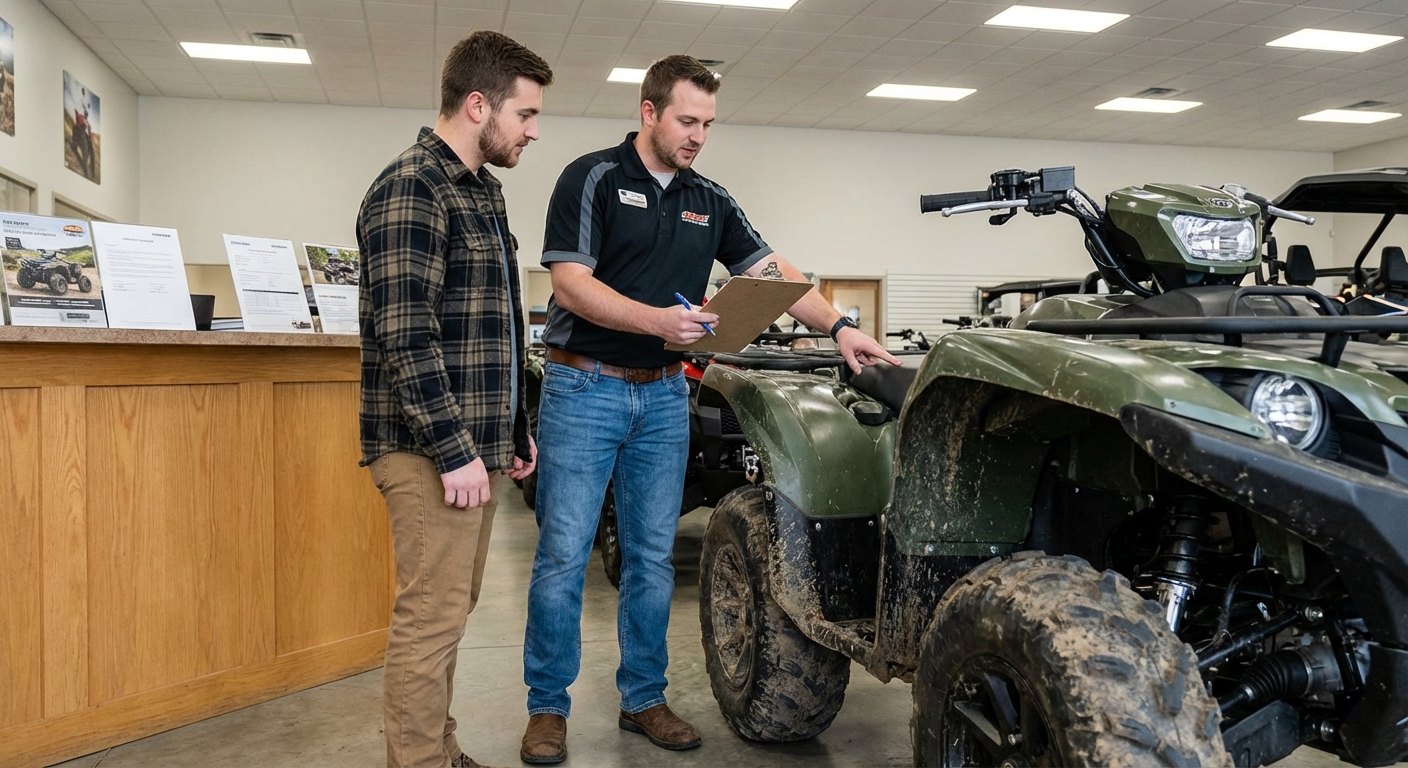
> “Low money down, no credit needed, ride today.”
Under the hood, though, here’s what’s actually happening.
Core structure
Most rent-to-own ATV deals work like this:
- You “rent” the ATV with the option to own after making a set number of weekly or monthly payments
- You don’t technically own it until the final payment clears
- Missed payments can mean repossession with no refund of what you already paid
- Total paid is usually much higher than the cash price
When I ran the numbers on one contract from a regional powersports dealer:
- Cash price: $5,999
- "Rent-to-own" weekly payment: $79/week for 156 weeks (~3 years)
- Total paid if completed: $12,324
That’s basically double the ATV’s price for the privilege of not using traditional credit.
And that’s not even the worst I’ve seen.
Key Contract Terms You Have to Understand
Here’s the stuff I now circle in red pen whenever I review one of these contracts for a friend.
1. Total cost of ownership
Don’t just look at the weekly or monthly payment. Look at:
- Number of payments (weeks or months)
- Payment amount
- Any “option to purchase” fee at the end
Do the math yourself:
> payments × amount + any final fee = total cost
Then compare that to:
- The MSRP on the manufacturer’s website (Yamaha, Honda, Polaris, etc.)
- A normal financing quote from a bank or credit union
- Local used ATV prices on Facebook Marketplace or Cycle Trader
In my experience, rent-to-own often runs 40–120% more than normal financing or a solid used ATV.
2. Ownership and repossession rules
This part is where people get burned.
Most rent-to-own contracts state clearly:
- You are not the owner until all payments are made
- If you miss a certain number of payments (sometimes just one or two), they can reclaim the ATV
- You usually don’t get back what you’ve already paid
When I tested one program, I asked the manager point-blank: “If I’ve paid for two years and miss three payments, do I lose it all?” He didn’t even flinch: “Yes, that’s how it works.”
3. Early buyout options
Some contracts allow an early purchase option at a discount.
Look for language like:
- “Early buyout price”
- “Discounted payoff amount”
- “Same-as-cash period” (e.g., pay it off in 90 days and only owe the sticker price)
If you know your income will improve—tax refund, bonus, seasonal work—this clause can make or break whether rent-to-own is even remotely reasonable.
4. Repairs, maintenance, and insurance
The big questions to ask (and get in writing):
- Who pays for repairs during the term?
- Is there any warranty, and is it from the dealer or the manufacturer?
- Are oil changes, tires, brake pads on you? (Usually yes.)
- Are you required to carry insurance, and at what level?
The Consumer Financial Protection Bureau (CFPB) has repeatedly warned that rent-to-own agreements can stack costs through add-ons and maintenance responsibilities that people don’t anticipate.
5. Hidden fees and add-ons
In my experience, the sneaky stuff lives in the fine print and the “extras” the salesperson slides in:
- "Processing" fees
- Setup or prep charges
- Delivery fees
- Mandatory GPS tracking fee (yes, I’ve seen this)
Ask for an itemized out-the-door cost sheet and don’t sign until you see every fee laid out.
Pros and Cons of Rent-to-Own ATVs (The Honest Version)
Where rent-to-own can make sense
From what I’ve seen, rent-to-own sometimes works for:
- Riders with very bad or no credit who can’t get approved anywhere else
- People who need an ATV for work (farm/ranch/property maintenance) and can’t wait months to save up
- Short-term situations where you’re planning to use an early buyout or same-as-cash window
The upsides:
- Low or no traditional credit check
- Fast approval process
- Predictable payment amounts
The big downsides
And the not-so-pretty side:
- Total cost is usually huge compared to other options
- You can lose the ATV and all your payments if you default
- Limited legal protections compared to standard installment loans
- Some dealers push lower-quality or heavily used machines through these programs
From a pure money perspective, I’d rather see someone buy a solid used Honda Rancher in cash than rent-to-own a shiny new sport quad at double the price.
The ATV Inspection Checklist I Use Before Any Deal
Now let’s talk about the machine itself.
Whether it’s rent-to-own, used, or “demo unit,” I treat every non-new ATV with a structured inspection. This is the exact checklist I used last fall when I helped a friend walk away from a sketchy 4×4 that looked clean but sounded… wrong.
1. VIN, title status, and recalls
First thing I do:
- Find the VIN (usually on the frame near the front or under the fender)
- Make sure it matches the paperwork
- Ask directly: “Is there a title or certificate of origin, and whose name is it in?”
Then, I plug the VIN into the manufacturer’s website or a recall database to check for open safety recalls. For example, the U.S. Consumer Product Safety Commission (CPSC) regularly posts ATV recalls for things like fuel leaks, steering failures, and brake problems.
If there’s an open recall and the dealer hasn’t fixed it—that’s a red flag.
2. Frame and chassis
I always crawl under the ATV. Literally.
Look for:
- Cracks or welds on the frame (repaired cracks are bad news)
- Rust, especially near welds and suspension mounting points
- Bent skid plates or rock rash indicating heavy abuse
When I tested a used utility ATV at a dealer, the frame looked fine from the side. Underneath, the lower A-arm mount had a fresh weld. That’s “we rolled this hard enough to break metal” territory. I passed.
3. Engine and fluids
With the engine cold:
- Check the oil level and color (milky = coolant contamination, black sludge = neglect)
- Look for oil leaks around gaskets, head, and drain plug
- Pop the radiator cap (engine cold only) and check for clean coolant
Then start it:
- It should start without excessive cranking
- Listen for knocking, loud ticking, or grinding
- Let it idle—watch for rough running or stalling
Rev it lightly and check the exhaust:
- Blue smoke = oil burning (worn rings/valves)
- White smoke after warmup = possible coolant issues
4. Drivetrain and transmission
On a test ride (which you absolutely should insist on):
- Shift through all gears or ranges (H/L/R/Park)
- For 4×4 models, engage 4WD and diff lock and feel for engagement
- Listen for clunks, grinding, or whining under load
A healthy ATV should shift with a solid, predictable feel, not like you’re forcing it into gear.
5. Suspension, steering, and brakes
I bounce the ATV at each corner:
- It should compress and rebound smoothly, no squeaks or binding
- Look for leaking shocks or blown seals
Check steering:
- Minimal play in handlebars
- No knocking when turning lock-to-lock
Brakes:
- Firm pedal/lever feel
- No grinding noises
- It should stop straight, not pull to one side
The U.S. ATV Safety Institute places huge emphasis on properly functioning brakes and steering—if either feels off, I treat it as a serious safety issue, not a “we’ll fix it later” item.
6. Tires, wheels, and controls
Tires:
- Look for uneven wear, sidewall cracks, or plugs
- Deep center wear with clean edges often means a lot of pavement use, which is hard on drivetrains not designed for it
Controls and electrics:
- Test throttle, kill switch, lights, display, winch (if equipped)
- Check every button and switch—if a dealer won’t fix obvious stuff now, imagine warranty service later
7. Test ride: how it feels
This is the part specs can’t tell you.
Pay attention to:
- Does it pull straight when accelerating and braking?
- Any vibrations that feel out of place?
- Does it feel underpowered for its displacement (which can signal tuning or compression issues)?
When I tested a mid-size ATV on a rent-to-own program, everything looked fine on paper. But under throttle, it had a weird front-end wobble at speed. That told me something was bent—tie rod, rim, or worse. I handed the keys back.
How I’d Approach a Rent-to-Own ATV (If I Had to Do It)
If I was absolutely set on rent-to-own, here’s how I’d play it:
- Price check hard: Compare the total contract cost to:
- Used machines from private sellers
- Traditional financing options (credit union, manufacturer financing)
- Negotiate the machine, not just the payments: Dealers will say, “It’s only $65 a week.” I’d respond: “Cool, but what’s the cash sale price of this exact ATV?” and push that number down.
- Get pre-approved elsewhere: I’ve had dealers magically improve terms once they realized I had a credit union loan offer in my pocket.
- Walk away power: The best leverage you have is being willing to say, “Thanks, I’m gonna think about it,” and leave.
- Use the inspection checklist: If they won’t let you inspect thoroughly or take a short test ride, that’s your sign.
Rent-to-own ATVs aren’t automatically evil—but they’re rarely the best option. When I stack them against buying used with cash or even conventional financing, they usually come in last on long-term value.
But if you go in eyes open, armed with the right questions and a ruthless inspection, you at least won’t get blindsided by fine print or a worn-out machine.
Sources
- Consumer Financial Protection Bureau – What is rent-to-own or rent-to-rent? – Overview of how rent-to-own contracts work and their risks
- U.S. Consumer Product Safety Commission – ATV Recalls – Official database of ATV-related recalls
- ATV Safety Institute – ATV Tips & Practice Guide – Safety and inspection guidance for ATV riders
- Yamaha Motors – ATV Lineup & Specifications – Example manufacturer specs and pricing to compare against dealer offers
- U.S. Federal Trade Commission – Rent-to-Own: Costly Convenience – FTC perspective on the true cost of rent-to-own agreements