Senior-Friendly Cars: Features to Look for in Comfort, Visibility, and Easy Entry
One hand on the door, the other on the roof, slow twist, awkward grunt. He looked at me and said, “Next car we buy, I’m interviewing it.”
That moment sent me down a rabbit hole of test drives, spec sheets, and honestly way too many hours in dealership lots. When I tested different models with him, I realized something: the cars that work best for older drivers aren’t necessarily the most expensive or the flashiest. They’re the ones that quietly nail three things:
- Comfort (especially seats and ride quality)
- Visibility (seeing out and being seen)
- Easy entry and exit (aka: no yoga moves to get in the car)
Let’s break this down like I wish a salesperson had done for us from the start.
Comfort: Seats, Ride, and Controls That Don’t Fight You
When I started researching, I kept running into one consistent theme in studies on senior driving: fatigue and pain lead to worse driving performance. The American Geriatrics Society has flagged joint pain and reduced flexibility as key risk factors for older drivers staying on the road safely.
In my experience, comfort isn’t a luxury for seniors — it’s a safety feature.
Seat height and cushioning
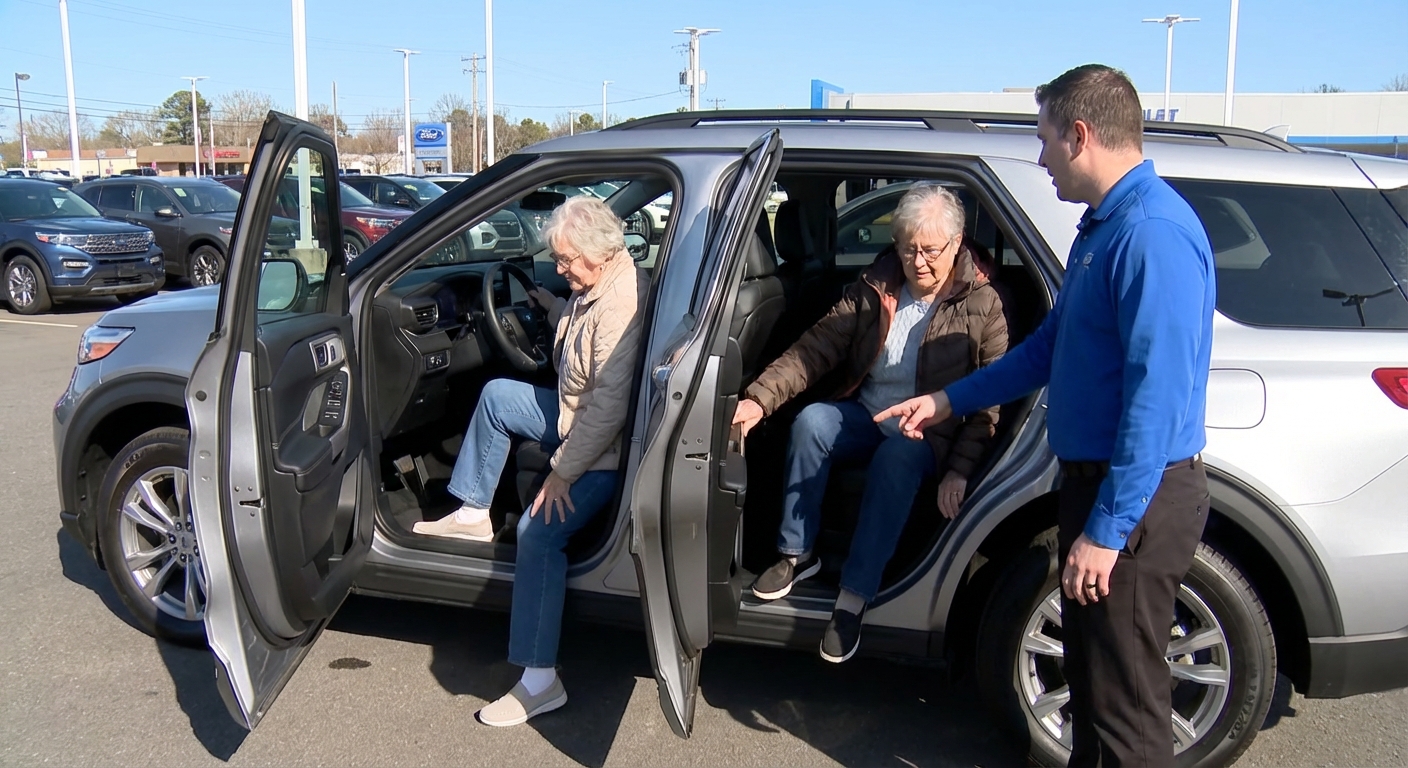
When I tested cars with my dad, the sweet spot for seat height was simple: he wanted to slide in, not climb up or drop down.
I’ve found:
- Very low sedans = hard to get out of, especially with hip or knee issues
- Very tall trucks/SUVs = hard to climb into, even with running boards
Most senior-friendly cars sit in that “chair height” zone: compact SUVs, crossovers, and some taller sedans. Look for:
- Seat height roughly at the back of the knee, so you can back up and sit, then swing legs in
- Firm but not rock-hard cushions, with good thigh support
- Power-adjustable seats with height, tilt, and lumbar support – manual levers can be stiff and awkward
When I tested a Subaru Forester with my mother-in-law (who has a cranky lower back), the thing she wouldn’t stop talking about wasn’t the all-wheel drive – it was the lumbar support and seat angle. After a 45-minute drive, she said, “My back doesn’t hate me. That’s new.”
Ease of controls
Touchscreens everywhere look modern, but for a lot of older drivers, they’re a nightmare.
Cars I’ve seen work best for seniors usually have:
- Big, clearly labeled climate knobs you can adjust without taking your eyes off the road
- Physical volume and tuning knobs instead of tiny touch sliders
- Simple, uncluttered steering wheel buttons
I once rode in a friend’s luxury SUV with a gorgeous 14-inch touchscreen… and watched his 82-year-old mom randomly change drive modes while trying to turn up the AC. Senior-friendly doesn’t always mean highest-tech; it means clear, predictable, forgiving.
Ride quality
A harsh, bouncy ride is painful with arthritis or back issues. On the flip side, a super-soft, floaty ride can make some seniors feel carsick or disconnected from the road.
When I test a car with an older driver in mind, I pay attention to:
- How it handles speed bumps and potholes
- Whether the car dives or wallows when braking or turning
- Road noise – loud cabins increase fatigue and stress
Mid-size crossovers and some compact SUVs often hit the sweet spot here. Some models even offer adjustable suspension or “comfort” drive modes, but I’d treat that as a bonus, not a requirement.
Visibility: Seeing Clearly Without Strain
The National Highway Traffic Safety Administration (NHTSA) has repeatedly pointed out that reduced vision and slower reaction times are big factors in older-driver crashes. That’s not fearmongering; that’s just how aging bodies work.
When I sit in a car now, I do a quick visibility test with seniors in mind.
High seating position and big windows
A slightly elevated driving position can be a game-changer. You see over parked cars better, and you don’t have to crane your neck forward.
I look for:
- Thin roof pillars (A, B, and C pillars) that don’t create giant blind spots
- Tall, wide windshield
- Large side windows and a rear window that isn’t a tiny slot
I recently sat in a sporty crossover where the window line was so high that my dad joked, “I feel like I’m driving from a bathtub.” Stylish? Yes. Senior-friendly? Not really.
Mirrors and camera systems
In my experience, older drivers benefit massively from tech that augments, not replaces, their awareness.
Useful features:
- Large, power-adjustable side mirrors with blind-spot indicators
- Auto-dimming rearview mirror to reduce glare at night
- Wide-angle rearview camera with clear, bright graphics
Advanced features like 360° surround-view cameras are genuinely helpful. I tested one with my aunt, who has limited neck mobility. Being able to see down the sides and front of the car on-screen made her parking way more confident.
But here’s the catch: tech only helps if it’s simple to understand and not overloaded with beeps and cryptic warnings.
Lighting that actually helps
This is underrated. Night driving is often the first thing older drivers give up, and there’s research backing that low-contrast and glare issues are a real problem.
What I look for:
- LED or HID headlights with clear cutoffs – they light the road better than old halogens
- Automatic high beams – less fiddling with stalks at night
- Good interior lighting, especially around the center console and door handles
When I drove a late-model Toyota RAV4 with a family friend in her 70s, she was shocked by how much more confident she felt driving after dark compared with her 15-year-old sedan. The headlights and auto high beams made the biggest difference.
Easy Entry and Exit: The Dealbreaker Feature
If you’ve ever watched someone with a replaced hip or sore knees try to climb into a low car, you know: door design might matter more than horsepower.
This was the number one complaint when I took my dad and two of his friends car shopping.
Door size and opening angle
Senior-friendly cars usually have:
- Wide-opening front doors (ideally close to 90 degrees)
- Door sills that aren’t too high or wide
- Rooflines that don’t force you to duck dramatically
On a Honda CR-V I tested, my dad could literally back up, sit down like he would at the kitchen table, and then just swivel his legs in. In a sportier sedan we tried the same day, he bumped his head on the roof twice.
Rear door access matters too, especially if seniors are passengers more than drivers. Wide rear door openings help both them and anyone assisting them.
Grab handles and step-in height
One of the most underrated features for seniors: grab handles mounted above the doors. Some brands still delete these in front to save money or look “cleaner” inside – and I think that’s a mistake.
I always check:
- Are there grab handles for both driver and front passenger?
- Is the floor height such that you can step in naturally, without hauling yourself up or dropping down?
Medium-sized crossovers (think Toyota RAV4, Subaru Forester, Hyundai Tucson) tend to nail this better than low sedans or massive trucks.
Door weight and closure effort
It sounds picky, but it’s not: heavy doors can be a real problem for someone with reduced upper body strength or arthritis.
When I tested a few European luxury cars, the doors shut with a satisfying thunk… but my dad actually struggled to pull them fully closed on an incline. In contrast, a Mazda CX-5 had lighter but still solid-feeling doors he could manage easily.
If someone uses a cane or walker, check how they:
- Maneuver it through the doorway
- Store it in the front passenger area or rear seat
I’ve watched this become the make-or-break detail more than once.
Helpful Safety Tech… Without Overwhelm
Advanced driver-assistance systems (ADAS) can be huge for senior drivers when used right. The Insurance Institute for Highway Safety (IIHS) and AAA have both found that features like automatic emergency braking and lane-keeping assist can reduce certain types of crashes.
From my hands-on testing with older relatives, the keepers are:
- Automatic emergency braking
- Forward collision warning
- Blind-spot monitoring
- Rear cross-traffic alert
Mixed bag:
- Lane-keeping assist – helpful for some, annoying for others if it feels too “grabby”
- Overly loud or frequent alerts – can cause anxiety instead of reassurance
When I set up a new car for an older driver, we spend 15–20 minutes in the driveway:
- Turning off or toning down beeps they hate
- Raising the volume on critical alerts
- Adjusting how aggressive lane-keeping is
The goal: tech that feels like a calm co-pilot, not a nagging backseat driver.
A Few Models That Often Work Well for Seniors
I’m not sponsored by any brand, and there’s no one-size-fits-all answer, but from what I’ve tested and seen repeatedly recommended by experts and organizations catering to older drivers, these categories tend to work well:
- Compact SUVs / crossovers: Toyota RAV4, Honda CR-V, Subaru Forester, Hyundai Tucson, Mazda CX-5
- Tall, upright hatchbacks / small crossovers: Subaru Crosstrek, Kia Soul
- Some mid-size sedans with higher seating: Toyota Camry (higher trims), Subaru Legacy
Pros of these:
- Easier entry/exit than low sedans
- Good visibility
- Better cargo access for mobility aids
Cons to keep in mind:
- Slightly higher step-in than a few “tall” sedans
- Fuel economy can be a bit worse than the smallest cars
- More features = more settings to learn
The real test is personal. I tell families: bring the actual senior, their actual coat, their actual shoes, and if relevant, their walker or cane – and do at least two long test drives.
How to Test a Car for Senior-Friendliness (Quick Checklist)
Here’s the exact process I use when I’m test-driving with an older driver:
- Entry/Exit Test – Get in and out three times from both front seats. If it feels like a chore now, it’ll be worse later.
- Comfort Test – Sit for 15–20 minutes with the car parked. Any pressure points? Back pain?
- Visibility Test – Adjust mirrors, look over shoulders, check blind spots, back into a parking space using mirrors and camera.
- Control Simplicity – Can they change temperature, volume, and radio station without hunting in menus?
- Real-World Drive – Include:
- A few tight parking maneuvers
- A highway merge
- A night drive, if possible, to test headlights
If the senior driver gets out of the car and says, “That wasn’t bad at all,” you’re very close. If they say nothing and just rub a knee or their neck, that’s your red flag.
Senior-friendly cars aren’t a special category buried in brochures – they’re regular vehicles that happen to be thoughtfully designed for real human bodies that have some miles on them.
When I tested cars with my dad, the ones that won weren’t the ones with the biggest screens or the fanciest badges. They were the ones that let him get in without pain, see the road without strain, and drive without feeling like he was fighting the car.
If a car can give that to someone you love – or to your future self – it’s worth more than any horsepower figure on the window sticker.
Sources
- NHTSA – Older Drivers – U.S. government guidance and data on aging and driving safety.
- AAA – Evaluating Vehicle Access, Visibility and Operation by Older Adults – Research and recommendations for senior-friendly vehicle features.
- IIHS – Crash avoidance features – Evidence on the effectiveness of advanced driver-assistance systems.
- American Geriatrics Society – Driving and Older Adults – Medical perspective on aging, mobility, and driving.
- Subaru – Forester Features – Example of visibility, ride height, and safety tech in a senior-friendly crossover.