The Strange Power of Background Music: How I Hacked My Day With Playlists
ing algorithms choose my background music and started designing playlists for specific moments in my day.
Within a week, my focus changed. My mood leveled out. And bizarrely, my apartment started feeling like a movie set—with me as the main character.
This isn’t some “just vibe higher” nonsense. There’s legit science behind how music alters your attention, memory, and even how food tastes. And once I started playing with it on purpose, my whole daily soundtrack flipped from random noise to something closer to a director’s cut.
Let me walk you through what actually worked, what backfired, and how you can turn your day into a low-budget (but emotionally high-quality) film using nothing but playlists.
How I Accidentally Turned Breakfast into a Movie Scene
One morning I put on an old jazz playlist while making eggs—Chet Baker, Bill Evans, that kind of moody, late-night café energy.
Something weird happened.
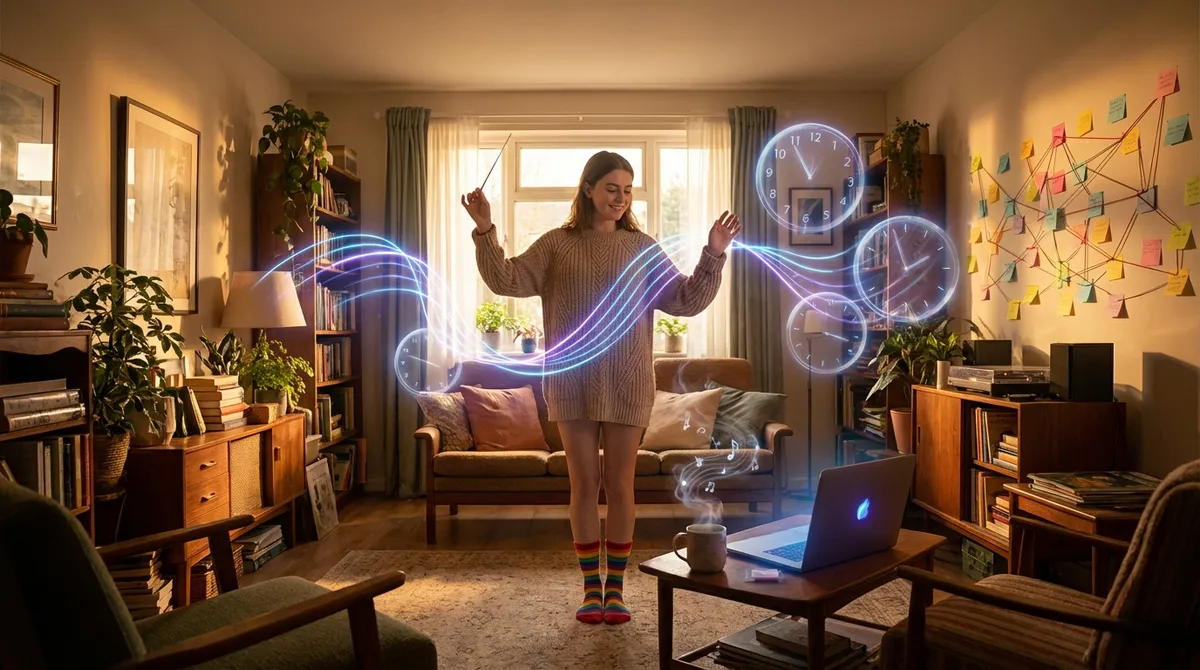
I didn’t grab my phone. I didn’t rush. I savored my toast like it was part of a scene where I’m the mysterious-but-kind main character figuring life out over coffee.
So I started messing with it. Different genres for different daily “scenes”:
- Jazz or soft piano for slow mornings
- Ambient electronic for deep work
- Upbeat pop or K-pop for cleaning
- Orchestral film scores while walking outside
When I tested this intentionally for a week, my days felt less like one endless notification and more like chapters. Same life, same chores, same laptop—but totally different emotional texture.
Later I found out there’s research backing this “soundtrack effect.” A 2019 study in Frontiers in Psychology explored how music shapes our emotional experiences and sense of meaning in everyday life, not just during “special” events. It’s literally called “the soundtrack of our lives” in academic language. That hit me right in the Spotify.
Once I realized I could steer my mood and attention like this, I went all in.
The Focus Playlist That Finally Beat My Doomscrolling
I used to write with random playlists or “lofi hip hop beats” in the background. It kinda worked—until lyrics snuck in, or I recognized a song, or an ad wrecked my concentration and suddenly I was on three different social apps and somehow reading about otters.
So I treated this like an experiment.
What I tried
- Pure instrumental film scores
I went full Hans Zimmer and Ludwig Göransson. “Tenet” and “Inception” for heavy tasks, “Interstellar” for long reading sessions. Dramatic? Absolutely. Effective? Way more than I expected.
- One-song loops
I picked a single instrumental track and looped it for 30–45 minutes. At first it felt repetitive. Then my brain stopped noticing it and used it as a focus “anchor.” Minimal cognitive switching, fewer distractions.
- Binaural beats & ambient noise
I’d seen YouTube videos claiming “Alpha waves for studying!! 10 HOURS!!” and always rolled my eyes. When I tested them, some were useless, but certain ambient tracks with subtle pulses or white noise gave me the same quiet-head feeling as a library.
What actually worked
In my experience, the best “focus music” has these ingredients:
- No lyrics (or lyrics in a language your brain doesn’t process easily)
- Consistent tempo with zero surprise drops
- Not associated with strong memories (nostalgia is focus kryptonite)
There’s research to back this. Studies show that music with lyrics can impair reading comprehension and complex tasks because your brain is trying to process words in two channels at once. The University of Wales did a fun one in 2010 where background music with changing words made recall worse compared to silence or steady sounds.
Now, my main writing playlist is 90% instrumental. If I catch myself wanting to pay attention to the song, it gets cut. Sounds harsh, but that’s how I keep the playlist from turning into a concert.
Why Sad Songs Sometimes Help More Than “Cheer Up” Bangers
When I’m low, there are two types of people in my life:
- “Let’s put on something upbeat and fix your mood.”
- “Here’s the saddest piano piece I know, you’re welcome.”
Weirdly, the second group often helps more.
One afternoon I was feeling totally burned out—work stress, social drama, the whole mess. Instead of blasting hype music, I put on a playlist of slow, melancholic tracks: Bon Iver, Agnes Obel, some minimal piano.
I didn’t magically feel “happy,” but I felt understood. That difference is massive.
Psychologists call this mood congruent music—you pick songs that match your current emotional state. A 2014 study in Frontiers in Psychology found that people often choose sad music not to wallow, but to feel comforted and emotionally validated. Sad music can work like a safe emotional mirror, not a trap.
The trick is knowing when you’re processing vs. spiraling.
What’s worked for me:
- If sad music helps me cry, journal, or actually feel something I’ve been avoiding → good sign.
- If I catch myself replaying the same track just to deepen the misery without moving anywhere → that playlist gets shut down.
Cheerful music isn’t bad—there’s also evidence that upbeat tunes can boost mood and even help some people with mild symptoms of depression. I just don’t force it anymore. I let my playlist meet me where I’m at, then slowly shift the tone if I feel ready.
Turning Ordinary Chores into Mini Performances
One Sunday I was cleaning my kitchen in complete silence, feeling like a background character in a vague beige drama. I grabbed my speaker, put on an aggressively joyful disco-funk playlist, and everything changed.
Wiping counters? Dance move.
Carrying trash out? Power walk.
Folding laundry? Sudden choreography attempt that my downstairs neighbors definitely did not appreciate.
This “soundtrack hijack” works way better for boring physical tasks than I expected. Up-tempo music is linked with increased movement and improved performance in repetitive or endurance tasks. Sports researchers have been on this for years—music can reduce the perceived effort of a task and even improve physical output by syncing movement to rhythm.
I started building chore-specific playlists:
- “Dishwashing Bangers” – songs I can’t sit still to
- “Laundry Room Raves” – dance tracks, remixes, high BPM
- “5-Minute Tidy Sprint” – 2–3 hype songs I know by heart
Now I tie cleaning to music instead of willpower. When the playlist starts, the body just… follows.
One warning: when I tried listening to podcasts while cleaning, I moved slower because my brain wanted to focus on the words. For anything physical and low-skill? High-energy music beats spoken word every time for me.
The Social Playlist Trick That Saved a Very Awkward Hangout
A few months ago, I hosted a small game night. The first 20 minutes were rough—no one knew each other, the room was quiet, and every shuffle of the snack bowl sounded like a thunderclap of awkwardness.
I’d made the classic mistake: I hadn’t prepped the room—aka, the soundscape.
So I paused the stilted conversation, casually hit play on a “warm background” playlist I’d built earlier: mid-tempo indie, light electronic, nothing too in-your-face but definitely not elevator music.
The effect wasn’t instant magic, but within 10 minutes:
- People talked more fluidly because silence wasn’t pressuring every sentence.
- Jokes landed better—music softens those tiny micro-pauses where people judge themselves.
- The whole night felt more like hanging at a chilled bar than sitting in a library that serves hummus.
There’s data around this too. In hospitality research, they’ve found that background music affects how long people stay, how much they spend, and even how they describe the atmosphere. And in everyday interactions, sound shapes how safe or exposed we feel.
Now, when I host:
- I choose music slightly faster than resting heart rate for energetic hangs.
- I avoid songs with super intense lyrics—no one wants to have a deep conversation over a breakup anthem.
- I test volume from a random corner of the room before guests arrive. If I have to raise my voice solo, it’s too loud.
I also learned the hard way that putting on your absolute favorite songs can backfire—you’ll keep wanting to skip or explain them instead of actually talking to people.
The Dark Side: When Background Music Starts Running You
I’d love to say “curating your own soundtrack fixes everything,” but that’d be fake. There are some very real downsides I ran into.
1. Dependency mode
At one point I realized I hadn’t done anything in silence for weeks. No walking without earbuds, no cooking without playlists, no quiet bus rides.
When my headphones died one day, I felt weirdly stripped—like someone turned off my personality.
I started scheduling “no soundtrack zones”: short walks, shower, first 10 minutes of the day. Silence made my brain itchy at first, then way clearer. Now music feels like a choice again, not a reflex.
2. Over-optimization
I went too far into “this playlist for emails, this BPM for sweeping, this genre for salad chopping” territory. It turned something fun into a control project.
Now I treat it more like costume design than a lab experiment: helpful, intentional, but flexible. Some days I work better in silence. Some days I put on chaotic hyperpop and answer emails at 2x speed. Both are allowed.
3. Not everyone’s brain loves background sound
A friend with ADHD told me that some types of music help her lock in, while others make her feel like her mind’s in five tabs at once. Another friend with sensory sensitivities finds most background music in cafés overwhelming, not pleasant.
There’s no universal “best focus playlist.” Neuroscience backs this up—people differ a lot in how their nervous systems respond to sensory input. So if your brain melts in a bad way with background music, you’re not “doing it wrong.” Your settings are just different.
How to Design Your Own Daily Soundtrack (Without Making It a Chore)
If you want to play with this without turning into a full-time playlist engineer, here’s what’s worked for me.
- Pick 3 “scenes” in your day
Not 20—just three. Example:
- Waking up
- Deep work or study
- Cleaning or moving
- Assign each scene a mood, not a genre
“Soft and curious,” “epic and focused,” “light and playful.” Then browse for playlists or build your own around that feeling.
- Test each for one week
Don’t change them every hour. Let your brain associate each playlist with each activity. After a few days, you’ll feel the shift as soon as the first track hits.
- Notice what breaks your immersion
For me: lyrics during reading, sudden volume jumps, or songs I have strong memories attached to. Those get cut.
- Keep a “wildcard” playlist
A totally chaotic, no-rules playlist for when you’re not trying to optimize anything and just want to live inside a song for a bit.
The goal isn’t to hack your productivity like you’re a robot. It’s to treat your daily life like low-budget art direction—using sound to nudge your mood, sharpen your focus, and make the boring parts a little more cinematic.
And honestly? Once you start noticing how music shapes everything—from your typing speed to how coffee tastes—you can’t unsee it.
Conclusion
I used to treat background music like wallpaper: vaguely nice, mostly ignored. After experimenting with it across my whole day—work, chores, hangs, even mini emotional breakdowns—I see it more like lighting in a film.
The scene is technically fine without it. But add the right soundtrack, and suddenly the same life feels richer, clearer, and more yours.
You don’t need fancy speakers or music theory. Just a bit of curiosity, three intentional playlists, and a willingness to press play on purpose instead of out of habit.
Your day already has a story. You might as well score it.
Sources
- How Music Affects the Brain – Harvard Health explains cognitive and emotional effects of music on the brain.
- The Emotional Power of Music in Everyday Life – Frontiers in Psychology article on how music shapes daily experiences and emotions.
- Effects of Background Music on Cognitive Performance – American Psychological Association summary of research on music, attention, and task performance.
- Why We Listen to Sad Music – Peer‑reviewed study exploring comfort, mood regulation, and the appeal of sad songs.
- Music, Exercise, and Perceived Effort – Research review on how tempo and rhythm influence physical performance and endurance.