Why Your First EV Road Trip Feels Scary (And How To Make It Awesome)
didn’t exist anymore. Spoiler: we survived. But that drive turned me from “EV-curious” into “EV-obsessed.”
If you’ve got an electric car (or you’re thinking about buying one) and the idea of leaving your city makes your stomach flip, you’re not alone. The good news? Once you understand how EVs really behave on the road, long-distance trips go from “range anxiety” to “this is actually kinda fun.”
Let me walk you through what I’ve learned from planning, messing up, and then perfecting EV road trips.
The First Time I Watched the Battery Drop… And Drop
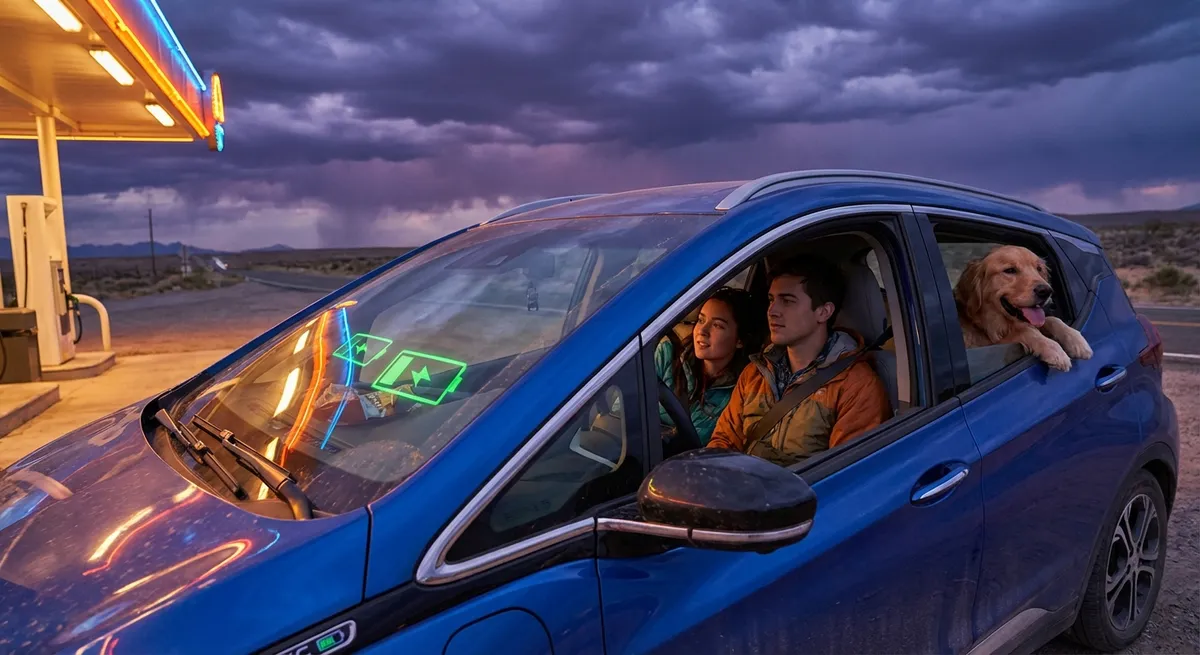
When I took my first highway trip in an EV, I made a classic rookie mistake: I treated the EV like a gas car. I set cruise control at 80 mph, cranked the AC, blasted music, and didn’t think about charging until the battery dipped under 20%.
Huge mistake.
At around 65% battery, I noticed the predicted range dropping faster than the miles left on the route. That’s when you start doing math in your head and bargaining with the universe.
What I eventually figured out:
- Highway speeds eat range faster than you expect. Aero drag is brutal above ~70 mph.
- Wind, temperature, and elevation changes can quietly murder your efficiency.
- EVs are brutally honest with you; their range estimates adjust in real time.
When I slowed down to 65 mph, I could literally see the projected arrival battery jump from 3% to 9%. That’s when it clicked: an EV road trip is less “drive ‘til you’re empty” and more “work with the car, not against it.”
Once you accept that, planning gets way easier—and way less stressful.
How I Actually Plan an EV Road Trip Now (Without Panic Refreshing Apps)
These days, when I plan a longer drive, I don’t just type the destination into Maps and pray. I use a combo of tools and a simple mental checklist.
I usually start with a dedicated EV route planner, not just a navigation app. When I tested A Better Routeplanner (ABRP) for a 600 km trip, it suggested realistic stops based on my car model, weather, and speed, while Google Maps just gave me the “shortest time” fantasy.
Here’s my process in practice:
- Start with real-world range, not brochure range.
My car’s rated at around 400 km (about 250 mi) on paper. In my actual experience, I budget for 280–320 km (175–200 mi) on the highway, depending on temperature and speed. I’ve seen ranges drop 20–30% in winter.
- Plan around fast chargers, not just “a charger somewhere.”
I actively search for DC fast chargers (often 50 kW, 120 kW, 150 kW, 250 kW+). On one trip, I leaned on a lone 7 kW AC charger at a hotel and charged from 18% to 90%… overnight. Never again on a tight schedule.
- Aim to arrive with 10–20% battery, not 1%.
The time I rolled into a station at 3% battery with a headwind and zero backup options was the last time I tried to “live on the edge.” Now I assume at least one backup charger might be down.
- Check real user comments before trusting any station.
I once drove to a “verified” charger icon, only to find it fenced off for construction. Apps like PlugShare and ChargePoint reviews saved me so many headaches afterwards—people post photos, uptime issues, and pricing.
What surprised me the most: after I learned this planning rhythm, EV trips actually felt calmer than gas ones. I don’t show up on fumes, I know where I’m stopping, and I’ve already picked coffee spots.
Fast Charging Isn’t Magic (But You Can Totally Game It)
When I first used a 150 kW fast charger, I thought I’d be done in 10 minutes. I plugged in at around 60% battery and sat there, waiting for some miracle speed.
Nope.
Here’s what I learned tinkering with different chargers and states of charge:
- The fastest charging happens when your battery is low, usually between ~10–40%. That’s when I’ve seen rates close to the advertised 120–150 kW.
- Above 60–70%, charging speed drops hard. It’s like filling the top of a glass carefully so it doesn’t spill—EVs slow down to protect the battery.
- Going from 10% to 60% can be faster than 60% to 90%.
Now I treat charging like pit stops, not “fill to 100% every time”:
- On road trips, I usually charge from ~10–15% up to 60–70%, then drive again.
- Those sessions often take 20–35 minutes on a decent DC fast charger in my experience, which lines up with the coffee + bathroom + stretch-your-back window.
One time, when I stubbornly pushed the car to 95% “to be safe,” I sat next to the charger for an extra 30 minutes for a tiny amount of extra range I didn’t actually need. That was when I understood why experienced EV drivers say: “Charge enough, not full.”
The caveat? If chargers are sparse in your region or you’re crossing long rural stretches, sometimes topping up higher is non-negotiable. The “only charge to 60–70%” rule works best where you’ve got a decent charging network.
The Not-So-Glamorous Stuff: Cold Weather, Heat, and Real-World Range
The first winter I had an EV, I walked out on a frosty morning thinking, “Cool, I’ve got 350 km of range.” Then I drove 80 km, looked down, and my car had burned 40% battery.
Reality check.
From my own trips and what the data shows:
- Cold weather (close to or below freezing) can shave 20–40% off your range, especially on short trips. Battery chemistry just hates the cold.
- Heating is surprisingly energy-hungry. Cabin heaters draw a lot of power compared to efficient EV heat pumps or just using the heated seats & steering wheel.
- Hot weather also hits range, but I’ve seen it be less dramatic than deep cold—AC uses energy, but not as violently as winter heating in my car.
What’s helped me:
- Preconditioning the car while it’s still plugged in (warming the battery and cabin before departure).
- Using seat heaters more and cranking climate control a bit less.
- Being conservative with range estimates in winter—if the car says 280 km, I plan as if I’ve got maybe 200–220 km, depending on conditions.
On the flip side, city driving in mild weather can feel magical. I’ve had days where the range estimator actually went up during downhill, stop-and-go driving thanks to regen braking. That’s something gas cars just can’t do.
The Surprising Ways EV Road Trips Are… Actually Better
When I tried convincing a gas-driving friend to join me on an EV weekend run, he had a whole list of fears: “What if there’s traffic? What if chargers are full? What if we get stuck?”
We went anyway. Halfway through the drive, he looked up from his phone and said, “Wait, we’ve already stopped? That didn’t feel like a ‘charging break.’”
Here are the upsides I’ve really felt—not marketing brochure stuff, actual on-the-road perks:
- Built-in breaks. I used to push 3–4 hours straight in a gas car. In the EV, I naturally stop around every 2 hours for 20–30 minutes. I arrive less wrecked and somehow less angry at everything.
- Quieter cabins. The lack of engine noise on long stretches is addictive. I can actually hear podcasts at a normal volume.
- Cheap “fuel” at home. On a road trip, fast charging can be pricey. But when I average everything out—including home charging at off-peak rates—the total cost over time has been noticeably lower than my old gas car.
- One-pedal driving in traffic. Regen braking makes stop-and-go less soul-destroying. Once I got the feel for it, I honestly missed it when I had to drive a regular automatic again.
Of course, it’s not all roses:
- In areas with weak charging infrastructure, planning can feel like solving a puzzle with missing pieces.
- Public charger uptime is still hit-or-miss in some regions. I’ve had to hop to a second or third charger more than once.
- Peak-hour queues at popular stations near big cities are very real. I’ve sat behind three other EVs at a mall charger on a Friday afternoon wondering why I didn’t just leave earlier.
But even with all that, I’ve never wanted to go back to pure gas for road trips. The vibe is different—slower in a good way, more planned, and honestly kind of nerdy-fun if you like optimizing things.
When an EV Still Might Not Be the Best Road Trip Choice (Yet)
I’m obviously pro-EV, but there are situations where I’d tell someone to think twice, at least for now.
From what I’ve seen and lived:
- If you regularly do very remote routes with minimal infrastructure (think rural deserts, mountains, or long unpopulated stretches) and can’t afford tight planning or detours, a conventional or hybrid vehicle might still be more practical.
- If your only charging option at home is a shared or unreliable outlet, road-trip prep gets more annoying because you’re starting half-empty too often.
- If local public charging networks in your region have poor reliability, frequent outages, or terrible app/payment systems, the frustration factor is high.
I’ve had a couple of trips where I thought, “If this charger is down, this day is going to be a mess.” That’s not a fun feeling, and not everyone wants that extra cognitive load.
The good news is the landscape is changing fast. Networks like Tesla Supercharger, Electrify America, IONITY, and others are expanding yearly. And a lot of newer non-Tesla cars are starting to get access to the Tesla network, which is a big deal in terms of reliability.
How to Make Your First EV Road Trip Not Suck
If I had to boil down everything I’ve learned into a few practical moves you can use this weekend, it’d look like this:
- Test your real highway range before a big trip.
Do a simple 100–150 km run at your usual speed, reset your trip meter, and note your consumption (kWh/100 km or mi/kWh). That tells you way more than the marketing number.
- Pick your main chargers and backups in advance.
For each planned fast-charging stop, I try to have at least one backup location within 20–40 km, just in case.
- Don’t chase 100% charge at every stop.
Aim for efficient windows: around 10–15% up to 60–70% when possible. It’s faster overall and feels more like natural breaks than big “refuel events.”
- Use the car’s own trip prediction tools.
Many modern EVs show estimated arrival battery % that updates dynamically. On one long drive, that number became my obsession—and it was eerily accurate when I kept my speed steady.
- Be flexible with expectations.
You’re probably not going to beat your gas-car record time on day one. Once I accepted that my EV trips were slightly slower but far less exhausting, they started feeling like part of the vacation, not the obstacle before it.
After a few trips, something funny happens: the “what ifs” that scared you at first become just another part of your routine. You know which apps to trust, how your car behaves in different weather, and when that 12% warning is serious and when it’s no big deal.
And one day, you’ll be the one calmly explaining to a nervous new EV owner at a charger that yes, they really can make it to the next stop with 14% left—because you’ve been there, sweating over the same number, and you know how the story usually ends.
Conclusion
I went from white-knuckling the steering wheel at 3% battery to casually planning 500+ km days in an EV—and the difference wasn’t some secret setting buried in a menu. It was understanding how charging curves work, how weather messes with range, and how to build my trips around my car’s strengths instead of fighting its weaknesses.
EV road trips are absolutely doable—fun, even—once you stop pretending the car is a gas burner with a quiet engine and start treating it like what it is: a computer on wheels with its own quirks, habits, and sweet spots.
If you’re on the fence about taking that first long drive, my honest advice is: do a medium trip first, maybe 150–250 km each way, plan your stops with a bit of redundancy, and treat the whole thing as an experiment. By the time you get home, you’ll know your car better than weeks of city commuting could ever teach you.
Sources
- U.S. Department of Energy – Fueleconomy.gov: Cold Weather and Electric Vehicles – Explains how low temperatures affect EV range and energy use
- Consumer Reports – Electric Vehicle Range Explained – Breaks down real-world vs. rated EV range and factors that impact it
- International Council on Clean Transportation (ICCT) – Effects of battery temperature and driving conditions on EV range – Research-based analysis of real-world EV range performance
- U.S. Department of Transportation – Alternative Fuels Data Center: Charging Infrastructure Trends – Data and overview of EV charging infrastructure growth and types
- Tesla Supercharger FAQ – Practical information on fast charging behavior, charging curves, and station use from a major network provider